

Views from the road, by Jaana Komscha-Härkönen, VP Strategic Partnerships & External Relations, Quanscient
I’ve spent the past months travelling around the world, through conference halls, executive meetings and a fair number of coffee queues. Everywhere I went, one thing was clear: quantum technology has left the lab. It’s no longer only a topic for research groups and scientists. A growing number of business leaders have started asking what it means for them.
Let’s be clear about where we are. Large-scale, fault-tolerant quantum computers are still being built, and most of the commercial value is still ahead of us. That’s exactly why it matters now. We’re talking about the future, and history keeps teaching the same lesson. When the big shift comes, the early adopters are the ones holding the advantage.
Wanted: translators
In every country I’ve heard the same call. We need a bridge between this complex technology and the people who make business decisions. In practice, it’s a language problem. Physicists speak in qubits and gate fidelities, while leaders speak in ROI, risk, and roadmaps.
Someone has to translate, and that someone doesn’t need to be a physicist. For instance, I’m not a scientist. I consider myself one of the translators, and it’s encouraging to see the whole ecosystem recognise why that role matters and act on it.
Translating also means being honest. Overselling quantum hurts the whole field. My formula is simple: honest, but forward-looking. Realistic about today and prepared for the quantum era.
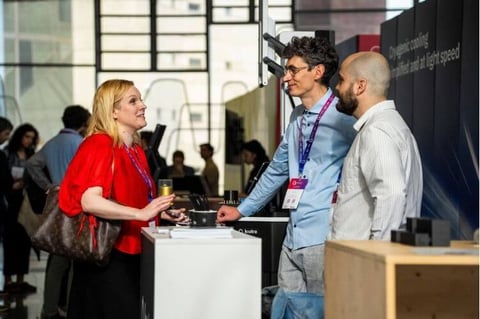
Q-Expo 2026 in Bilbao, Spain
“We’ll wait until it’s ready”
I hear this from leaders regularly. Sure, you can do that. But if you start building awareness only once everything is up and running, you’re already late.
Picture this: you’ve just arrived at the train station, ticket in hand, but your competitors have already boarded and the train is long gone.
This isn’t hypothetical either. In 2024, Airbus and BMW were already running a quantum computing challenge for industrial problems, and our team, together with Haiqu, was among the finalists.
Being ready starts long before you ever touch a quantum computer. It means knowing which of your problems could benefit from quantum, building know-how in-house and having the right partners in place before the hardware matures.
Be the first to benefit from quantum-powered simulation in CFD
Build algorithms with us today to make quantum CFD your competitive advantage.
Explore our quantum algorithmsWhen I talk with business leaders, the conversation turns to use cases within minutes, and it should.
Suppose I explained the benefits of quantum technology like this: Superposition and entanglement let us explore an exponentially large state space and with error-mitigated variational circuits we can estimate expectation values beyond classical reach. Guess how many follow-up meetings that would get me? Exactly.
That’s why our quantum team works on computational fluid dynamics (CFD). CFD simulates how air and water flow around wings, hulls, vehicles and more. In aerospace, maritime, automotive and defence, high-fidelity flow simulation is enormously expensive to compute, and better simulation translates directly into fuel savings, performance and faster design cycles.
Here’s what that looks like in practice. Earlier this year, our team and Haiqu simulated fluid flowing around a solid obstacle, which is the basic situation behind every wing and hull, over 15 time steps on IBM’s Heron R3 quantum processor. It’s the most physically complex simulation of its kind publicly documented on real quantum hardware, and the algorithm behind it needs fewer qubits and fewer operations than earlier approaches.
In business terms: it’s a small benchmark, not a full aircraft. But the distance between a lab exercise and an engineering problem is shrinking, and the companies that learn now how to frame their own flow problems for quantum will be the first ones able to use it.
I can tell you from experience that nothing gets a room leaning in like a real business problem. I’ve watched polite nods turn into “can we talk after this?” Bringing problems that are out of reach today closer to a solution, while saving time and money? That’s a good starting point for any business.
Proven on real quantum hardware
Our public demonstrations include 5 world-first CFD simulations, run on physical quantum hardware and ideal simulators.
Apr 2026IBM Heron R3 Nonlinear fluid flow past obstacles
With Haiqu → Jul 2025
Ideal simulator Industrial aerodynamic benchmarking, NACA0012 airfoil → Jul 2025
IonQ Aria 1 High-resolution fluid mechanics on a 64×64 grid
With Haiqu and AWS · Airbus and BMW Quantum Mobility Challenge → Jul 2025
IQM Emerald First 3D advection–diffusion on a superconducting chip
With IQM → Mar 2025
VTT Q50 First multi-time-step QLBM simulation on superconducting hardware
With VTT and IQM → Jan 2024
Fujitsu simulator Algorithmic scalability on up to 33 simulated qubits
First prize, Fujitsu Quantum Simulator Challenge → Aug 2022
Quantinuum H1-1 First quantum lattice Boltzmann simulation on physical hardware →
Where is quantum on your radar?
If you’re a business leader whose job is to think about the future and quantum isn’t on your radar yet, it might be time to get to the station.