Single-cell simulation hides the array
The effects that decide whether a transducer works — crosstalk, radiation, real beam shape — are array-level. Model one cell at a time and you don't see them until the wafer comes back.
The array won't fit in memory
So you simulate element by element and stitch assumptions together. The array-level behaviour is never solved.
Crosstalk is left out
Inter-element coupling doesn't enter a single-cell model, then reappears as artefacts in the measured beam profile.
Model and measurement diverge
Simplified models can lead to serious discrepancies with experiment, so the prototype is the first honest look at the device.
CMUT setup is a bottleneck
Full CMUT models are hard enough to set up that one specialist becomes the constraint on the whole project.
Array-scale MUT simulation, fully coupled
One model, all the physics, at array scale, run on the cloud and driven from your own scripts.
Array-scale modelling
Crosstalk, acoustic radiation, and propagation solved together across the array, including viscoelastic damping in packaging and lens layers that acoustic-only tools skip.
Natively coupled physics
Electrical, mechanical, and acoustic interactions in one unified model, solved simultaneously rather than handed sequentially between separate solvers.
Cloud scale, from code
Sweep hundreds of design variants overnight with parallel cloud compute. Write the loop once in the Python SDK and feed results straight into surrogate training.

What that makes possible
Two PMUT examples of the kind of study that isn't practical when every run takes hours on a desktop.
65 → 100%
Fractional bandwidth, from parametric limit to inverse-designed
10,000 simulations trained an AI surrogate that predicts device physics in under a millisecond. Inverse design then pushed PMUT fractional bandwidth from 65% to roughly 100% while holding the 12 MHz centre frequency.
260× faster
1,000 runs in 15 minutes, not 66 hours
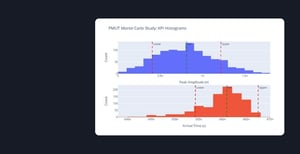
A yield study ran 1,000 Monte Carlo simulations in about 15 minutes instead of 66 hours, predicting 71.9% manufacturing yield for a strongly coupled piezoelectric-acoustic sensor and flagging oxide thickness as the critical parameter.
Every avoided prototype run pays for the tool
MEMS development is expensive because each device needs its own bespoke process, built and validated across multiple fab-dependent stages. A medium-complexity device runs to a minimum of ~$4M in engineering budget over roughly four years. Every prototype iteration you can resolve in simulation instead of silicon takes cost and months out of that path.
Source: Fitzgerald, White & Chung, "MEMS Product Development: From Concept to Commercialization" (Springer), Ch. 3, Table 3.2.
$1.5M
Minimum engineering budget for the advanced-prototype stage alone, for a medium-complexity MEMS device.~4 years
Typical span from proof-of-concept to foundry pilot production — each fab-dependent stage is roughly a year.$4M
Minimum total engineering budget across the four development stages, before overhead or capital expenses.PMUT and CMUT simulation questions
Can Allsolve simulate a full PMUT or CMUT array instead of a single cell?
Does it capture crosstalk between array elements?
How does it couple electrical, mechanical, and acoustic physics?
How much faster is cloud simulation than desktop FEM for MUTs?
Can I run manufacturing-yield or Monte Carlo studies?
Does it fit a scripted or Python workflow?
Can it help with CMUT setup complexity?
Not sure if Allsolve fits your MUT design?
Talk to our engineers about your application and how Allsolve could help in practice.
Case examples and other resources

Webinar + PDF summary
Accelerating MUT design with cloud-based multiphysics simulation
Download the PDF summary covering case examples of design optimization of CMUT and PMUT devices with Quanscient Allsolve.
Download PDF summary →
Case example
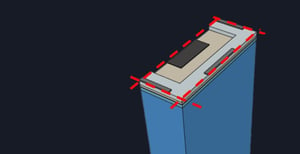
Enhancing MUT design and performance with Quanscient Allsolve
Designing high-performance MUT arrays is challenging due to limited simulation capabilities. See how Allsolve has changed this.
Read the full article →
Case example
Optimizing designs by simulating thousands of design variations
Explore a case study covernig how to run thousands of simulations in parallel with Quanscient Allsolve.
Read the full article →
See how it could work for you
Submit the form to talk with our experts—we'll respond within 1 business day. You'll learn:
- How Allsolve could fit your use case
- What results to expect (accuracy, runtime, design exploration capabilities and rough cost range)
- How it could plug into your workflow today
Interested in just seeing an on-demand demo? Watch the 3-minute demo here