Skip to content

Louder microspeakers, without the distortion

Simulate the nonlinear coupling that sets SPL and THD across thousands of designs at once, so an AI surrogate can find the best microspeaker design before you build one.

Nonlinear  •  Harmonic Balance  •  Cloud + Python SDK

microspeakers
Nilavazhagan Subbiah, PhDStaff Engineer
“Quanscient Allsolve enables large-scale multiphysics simulations of PMUT and CMUT arrays that would be challenging to achieve with other simulation tools. Its unique capabilities have helped us push the boundaries of what can be simulated in ultrasonic MEMS design.”
PixierayAntony Hartley, CAE Consultant
"With Quanscient Allsolve, we were able to test different parameters to find the working design from the first iteration, saving three months in product development time."
kiutraKlaus Eibensteiner, Team Lead of Engineering
“Quanscient Allsolve made our hardware iterations much more reliable and functional, speeding up the development process by requiring fewer hardware iterations to get to a finalized product.”
The gap

Linear simulation can't see distortion

Distortion is what limits how loud a microspeaker can play cleanly, and it's a nonlinear effect. The tools most teams reach for either can't see it or can't afford to explore it.

01

Linear FEM shows zero distortion

Linear finite-element models return THD = 0 at any drive level. The nonlinearity that creates distortion isn't in the model.

02

Transient runs don't scale

Transient FEM captures the nonlinearity, but running thousands of variants for a real design-of-experiments is computationally prohibitive.

03

Hand-tuning misses the optimum

So you optimise a few points by hand and never map the full SPL–THD trade-off, let alone find its true Pareto front.

04

Distortion surfaces on the bench

By the time the prototype is measured, the tooling and cost are already committed.

What Allsolve does

Nonlinear microspeaker simulation, at scale

One nonlinear model for the physics that set SPL and THD, run across the whole design space on the cloud and driven from your own scripts.

dataflow-03

Nonlinear physics, solved together

Solid mechanics, electrostatics, and air flow coupled in one nonlinear model. Harmonic distortion shows up in the result instead of being assumed away.

bar-chart-square-check

Harmonic Balance for THD

Frequency-domain Harmonic Balance computes THD efficiently, without the runtime cost of transient simulation. That makes it practical across thousands of designs.

cloud-blank-01

Cloud sweeps to AI surrogate

Sweep the design space on the cloud from the Python SDK, train an AI surrogate on the results, and explore SPL–THD trade-offs cheaply, once the surrogate is trained.

Proven on real microspeakers

What that makes possible

The kind of search that isn't practical when every distortion run takes hours on a desktop.

Harmonic Balance — AI surrogate

+30% SPL

At THD below 0.15%, well under the 1% target

A nonlinear Harmonic Balance study ran 12,500 simulations in 20 minutes to train an AI surrogate, which found a Pareto-optimal design delivering roughly 30% higher sound pressure while holding total harmonic distortion below 0.15%.

Open the full example →

Monte Carlo — Yield

72% yield

Manufacturing tolerances mapped, not guessed

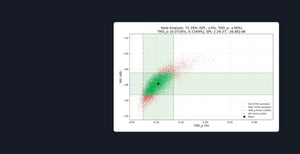
Feeding the surrogate into a Monte Carlo analysis mapped ±10% manufacturing tolerances to a predicted 72% production yield. The design is chosen for what survives fabrication, not just what performs on paper.

Open the full example →

The business case

Every avoided prototype run pays for the tool

Consumer-audio MEMS competes on iteration speed, and every microspeaker still rides the same expensive MEMS development path. A medium-complexity device runs to a minimum of ~$4M in engineering budget over roughly four years. Every design question you settle in simulation instead of silicon takes cost and months out of that path.

Source: Fitzgerald, White & Chung, "MEMS Product Development: From Concept to Commercialization" (Springer), Ch. 3, Table 3.2.

$1.5M

Minimum engineering budget for the advanced-prototype stage alone, for a medium-complexity MEMS device.

~4 years

Typical span from proof-of-concept to foundry pilot production — each fab-dependent stage is roughly a year.

$4M

Minimum total engineering budget across the four development stages, before overhead or capital expenses.
Resources

Case examples and other resources

microspeakers-1
Webinar + PDF summary

Faster, more reliable MEMS design with cloud multiphysics

Download the PDF summary on running large-scale MEMS design and optimization on the cloud with Quanscient Allsolve.

Download PDF summary →
microspeakers-2
Technical example

MEMS speaker yield optimization with MultiphysicsAI

See how 12,500 nonlinear simulations trained an AI surrogate to raise SPL ~30% while holding THD below 0.15%.

Open the example →

microspeakers-3
Case example

MultiphysicsAI for MEMS microspeaker design

A full walkthrough of the Harmonic Balance and AI-surrogate workflow behind the microspeaker optimization case.

Read the full article →

FAQ

MEMS microspeaker simulation questions

Can Allsolve simulate harmonic distortion (THD) in a MEMS microspeaker?
Yes. Allsolve models the nonlinear coupling between solid mechanics, electrostatics, and air flow, so total harmonic distortion appears directly in the result instead of being assumed to be zero as it is in linear FEM.
Why does linear FEM report zero THD?
Linear finite-element analysis has no nonlinear terms, so it returns THD = 0 at any drive level. Distortion is inherently a nonlinear effect, which is why it only appears once the model captures that nonlinearity.
How does Harmonic Balance help?
Harmonic Balance computes distortion in the frequency domain, giving THD and SPL efficiently without the long runtimes of transient simulation — which makes it practical to evaluate thousands of designs.
Can it find the SPL–THD trade-off automatically?
Yes. Cloud sweeps generate a dataset that trains an AI surrogate, which maps the Pareto front so you can pick the best sound pressure at an acceptable distortion level. In a published study this found a design with about 30% higher SPL while keeping THD below 0.15%.
Can it account for manufacturing tolerances and yield?
Yes. A Monte Carlo analysis over the surrogate maps manufacturing variation to predicted yield. A published microspeaker study mapped ±10% tolerances to a 72% predicted production yield.
Does it scale across a product family?
The same Python pipeline is reused for each size class, so you're not rebuilding the workflow every time — the setup carries over even when the device doesn't.
Does it fit a Python or scripted workflow?
Yes. The Python SDK lets you script parameter sweeps and run them on the cloud, then feed the results straight into surrogate training or an existing engineering pipeline.
Abstract-mesh-3
Quanscient Allsolve

See how it could work for you

Submit the form to talk with our experts—we'll respond within 1 business day. You'll learn:

  • How Allsolve could fit your use case
  • What results to expect (accuracy, runtime, design exploration capabilities and rough cost range)
  • How it could plug into your workflow today

Interested in just seeing an on-demand demo? Watch the 3-minute demo here