
Skip to content

Nonlinear fluid flow past an embedded obstacle

Successfully ran a multi-step nonlinear fluid simulation interacting with a solid object on a quantum processor. Outlined a practical algorithmic pathway for moving beyond linear demonstrations toward realistic engineering applications.

 

7 - Hero
Date:  April 2026  •   Hardware: IBM Heron R3 •   Partners: Haiqu

What we achieved

We achieved the most physically complex, publicly documented hardware demonstration of a quantum fluid simulation to date.

Moving beyond simplified, linear simulations in empty spaces, we successfully executed a 15-step nonlinear fluid benchmark. For the first time, we modeled moving fluid dynamically interacting with an embedded solid obstacle on a physical quantum device.


The approach

Embedding a physical object within a quantum grid usually requires multi-controlled quantum gates that create circuits far too deep for today's hardware to survive.

  • We utilized the IBM Heron R3, one of the largest and most stable superconducting quantum processors currently available.

  • We deployed a radically novel computational framework called the One-Step Simplified Lattice Boltzmann Method (OSSLBM).

  • The OSSLBM ingeniously fuses the traditionally separate collision and propagation mathematical phases into a single, unified quantum operation.

  • By combining our streamlined algorithm with targeted error-reduction middleware from Haiqu, we dramatically reduced the two-qubit gate count from 1825 to just 540, maintaining algorithmic convergence despite ambient hardware noise.

The impact

Simulating highly nonlinear Navier-Stokes problems around geometric obstacles is considered the holy grail of industrial computational fluid dynamics.

  • It proves that a practical algorithmic pathway now exists to move quantum computing out of theoretical academic research and directly into enterprise R&D workflows.

  • It maps a clear roadmap for resolving complex turbulence and solid boundaries, which is essential for analyzing chaotic airflow over commercial jet wings or hydrodynamics on massive ship hulls.

  • It establishes that as hardware scales, solving industrially relevant nonlinear fluid dynamics will reach commercial viability much sooner than the industry previously anticipated.
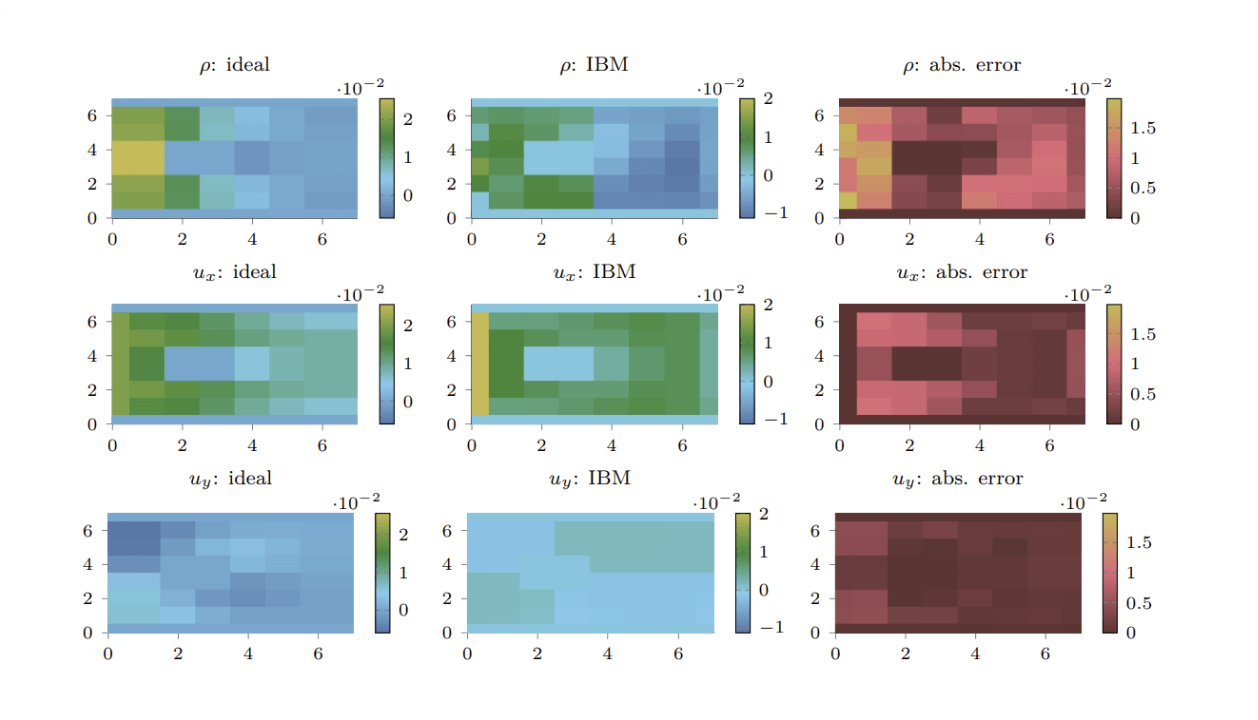
7 - Latest wioth Haiqu
Field data results after 15 time steps comparing the ideal theoretical simulation (left) with actual execution on the IBM quantum processor (center). Despite hardware noise, the quantum device successfully captured the complex density and velocity patterns of the fluid flow.