
Skip to content

High-resolution fluid mechanics on trapped-ion hardware

Executed a highly complex fluid mechanics simulation on a spatial grid using trapped-ion hardware and error-mitigation middleware. Advanced the state of the art toward solving industrial-scale engineering challenges in aerospace and automotive sectors.
 

5---Hero
Date:  July 2025  •   Hardware: IonQ Aria 1 (via Amazon Braket) •   Partners & Context: Airbus and BMW Quantum Mobility Challenge, Haiqu, AWS

What we achieved

As part of the Airbus and BMW Quantum Mobility Challenge, we achieved record-breaking, high-resolution results for quantum fluid mechanics on physical hardware.

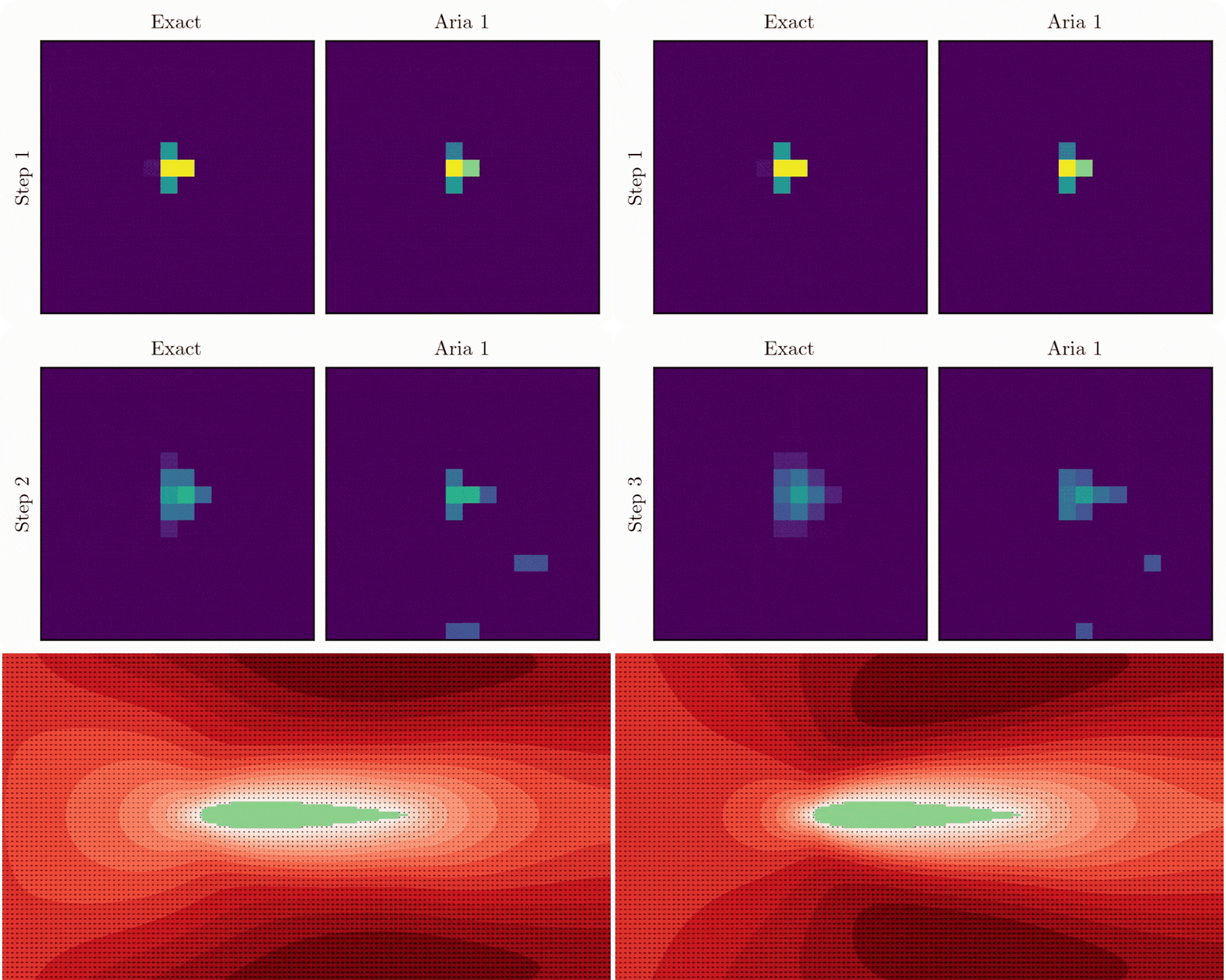
We successfully executed three distinct, consecutive steps of time evolution on a highly dense 64x64 spatial grid. This drastically surpassed previous hardware constraints reported in academic literature, proving that highly complex physics can be sustained on near-term devices.


The approach

We mathematically encoded a massive 64x64 spatial grid utilizing just 16 qubits. Even smaller 12-qubit versions of this model required a massive depth of 802 quantum gates—which would ordinarily yield completely unusable data due to rapid decoherence.

  • The simulation was orchestrated entirely on AWS using Amazon Braket, running directly on the IonQ Aria 1 trapped-ion device.

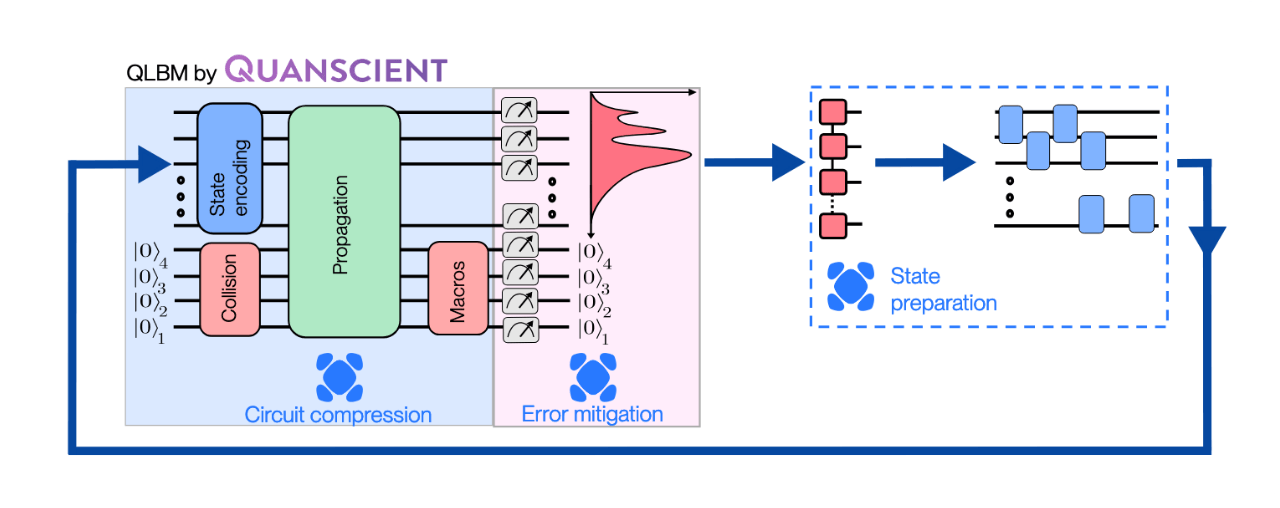
  • We integrated Quanscient's tailored algorithmic subroutines with Haiqu's application-agnostic error-mitigation middleware.

  • By utilizing Haiqu's approximate subcircuit compilation and lightweight noise mitigation, the physical hardware results closely matched our theoretical, exact mathematical simulations despite the extreme gate depth.

The impact

This demonstration addressed the primary skepticism surrounding near-term quantum computing: severe circuit depth limitations caused by hardware noise.

  • It completely validates immediate enterprise investment in hybrid quantum-classical workflows. You don't have to wait ten years for fault-tolerant hardware to see value.

  • By extracting accurate data from noisy hardware via intelligent middleware, global aerospace and automotive manufacturers have a clear path to analyzing complex aerodynamics and thermomechanical stress much sooner than anticipated.
5 - IonQ
Visual breakdown of the optimized hybrid quantum workflow. Integrating Quanscient's fluid dynamics algorithms with Haiqu's error mitigation ensures highly complex simulations can run reliably on today's near-term hardware.