
Multi-time-step 2D fluid simulation
World's first multi-time-step fluid simulation executed on a superconducting quantum computer. Brought quantum-enhanced computational fluid dynamics closer to continuous real-world engineering applications.
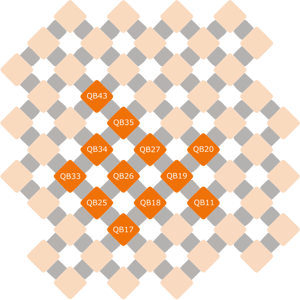
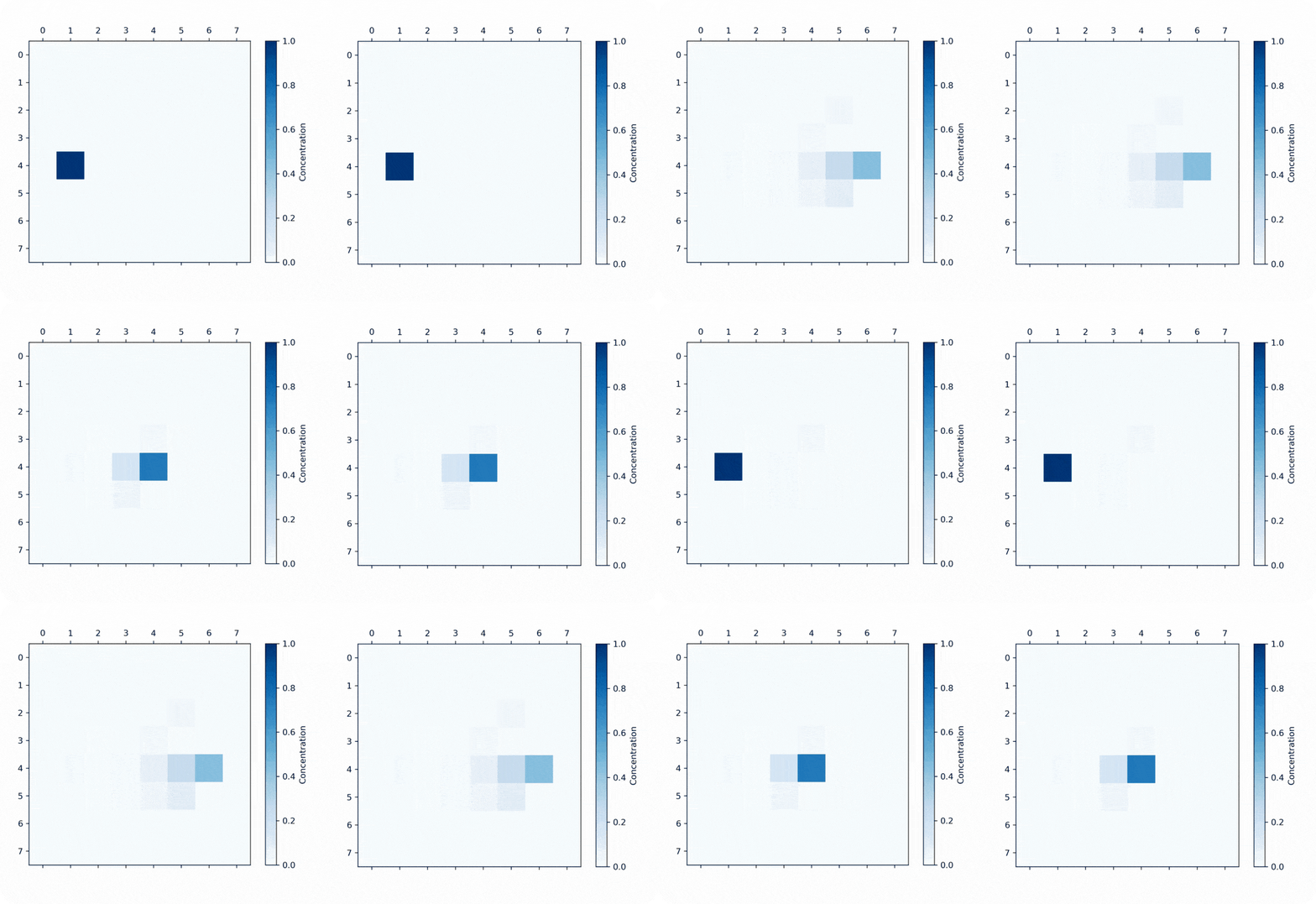
Showcased at the official launch of Europe's first 50-qubit superconducting quantum computer, we achieved the world's first multi-time-step computational fluid dynamics simulation on actual superconducting hardware using the Quantum Lattice-Boltzmann Method (QLBM).
Moving beyond highly constrained single-step proofs of concept, we successfully advanced a two-dimensional fluid state through continuous, consecutive increments of time.
Simulating multiple time steps without intermediate measurements has historically been a severe challenge due to the linear nature of quantum algebra and rapid amplitude dissipation.
The simulation was executed on the VTT Q50 machine using exactly 12 qubits to model a 2D advection-diffusion equation.
We meticulously optimized the quantum circuits specifically for the VTT Q50's logic gateset.
Simulating multiple consecutive time steps is the absolute prerequisite for real-world engineering.
Fluid dynamics in aerospace or automotive design do not exist in a single frozen moment. They are constantly evolving, continuous processes.
This breakthrough signaled to the industry that quantum hardware is actively transitioning from static mathematical problem-solving to highly dynamic system modeling.