
Skip to content

Large-scale scalability analysis on Fujitsu quantum simulator

Analyzed the execution time and gate depth scaling for complex advection-diffusion algorithms utilizing dozens of qubits. Provided valuable insights into the operational performance of quantum algorithms on emulated future hardware environments.
 

2 - Hero
Date:  January 2024  •   Hardware: Fujitsu Quantum Simulator •   Context: Fujitsu $100,000 Quantum Simulator Challenge

What we achieved

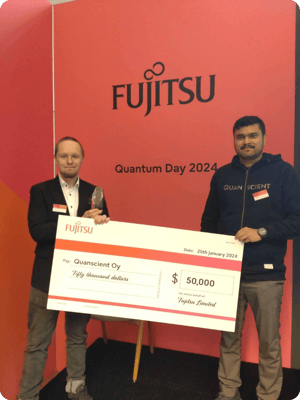
As the first prize winner of the global Fujitsu Quantum Simulator Challenge, we successfully executed 1D and 2D algorithms for both advection-diffusion and complex Navier-Stokes equations to evaluate their performance as the problem size expands.


The approach

We utilized the advanced Fujitsu Quantum Simulator to emulate an environment of perfectly coherent qubits, allowing us to test at scales currently impossible on physical chips.

  • We successfully ran a 1D advection-diffusion algorithm using a massive 33 qubits, and a 2D version utilizing 28 qubits.

  • We mathematically analyzed the execution times and the total number of quantum gates required as the simulated fluid lattice expanded.

The impact

This project gave us the exact operational performance curves for our quantum algorithms.

  • It shows exactly how gate depth increases as the fluid lattice size grows, which is critical for optimizing algorithms before real utility-scale hardware arrives.

  • It proves that companies can develop and test quantum-based engineering solutions right now in emulation.

  • When large-scale quantum computers become commercially available, code optimized through these benchmarks can be instantly migrated to physical hardware for an immediate competitive edge.
2---Fujitsu
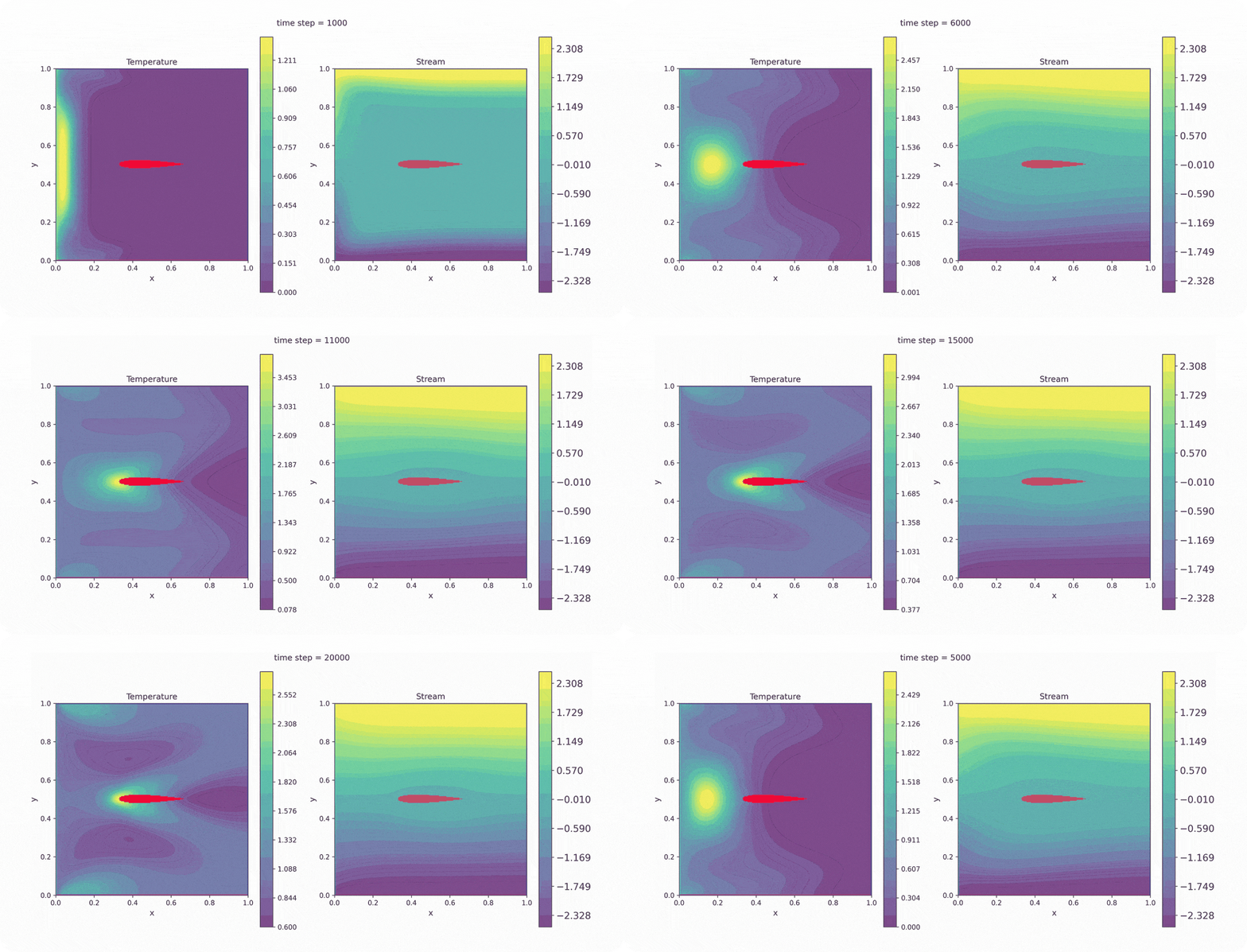
Temperature and stream fields from a 2D airfoil simulation.