
Python-native multiphysics simulation
Natively coupled, cloud-scale multiphysics fully accessible from your code editor.
AI surrogate training • Automated yield optimization • Agentic engineering

Why Quanscient SDK?

The SDK connects directly to Quanscient's cloud-native solvers, allowing you to run thousands of highly coupled multiphysics simulations concurrently.

Define entire workflows in Python, enabling Git version control, reproducibility, and frictionless collaboration across your R&D department.

Programmatically extract raw simulation data at scale to build proprietary datasets, train high-fidelity AI surrogate models, that make performance predictions in milliseconds.
Limitations with the traditional approach

Legacy CAE tools were built for desktop UIs, not headless execution. Forcing them into automated loops often results in unresolved crashes, hanging processes, and a lack of machine-readable error codes—breaking autonomous workflows.

Traditional tools lock parallel compute behind rigid, core-locked licensing matrices. This makes running the thousands of concurrent simulations required for modern R&D and AI training prohibitively expensive.

Incumbent APIs rely on outdated bridges—like Java Virtual Machine (JVM) singleton limits or Windows-only COM interfaces—that fundamentally prevent deployment on the cost-effective, massively parallel Linux cloud clusters used in modern tech stacks.
Training of AI surrogate models
Orchestrate the generation of tens of thousands of data points to train neural networks, enabling instant performance predictions for complex devices like PMUT arrays or MEMS speakers.
.png?width=300&name=1%20(5).png)
Automated yield optimization
Script massive Monte Carlo analyses to simulate how manufacturing tolerances impact performance, allowing teams to maximize device yield before physical prototyping begins.
.png?width=300&name=2%20(6).png)
Agentic engineering & prompt-based workflows
Hook the SDK up to enterprise LLMs to allow autonomous AI agents to write JSON configurations, dispatch simulations, and plot results based on natural language prompts.
--> See a full step-by-step example
.png?width=300&name=3%20(4).png)
See the SDK in action
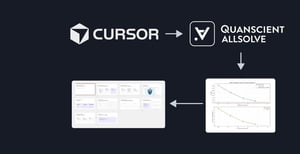
Blog
Agentic AI for multiphysics simulation is here
See an AI agent build, optimize, and validate a PMUT design end-to-end — 10,000 variations and a 35% bandwidth gain, all from code.
.jpg?width=300&name=2%20(2).jpg)
Webinar recording
The 3 pillars of optimal MEMS design
The full technical breakdown, with a timestamped recording you can jump straight to the parts you care about.
.jpg?width=300&name=SDK%20page%20examples%20(1).jpg)
Documentation
Quanscient Allsolve SDK documentation
Visit our docs for the API reference, setup guides, and code examples to get your first simulation running
See how it could work for you
Submit the form to talk with our experts — we'll respond within one business day.
“Quanscient Allsolve's unique capabilities have helped us push the boundaries of what can be simulated in ultrasonic MEMS design.”
Nilavazhagan Subbiah, PhD — Staff Engineer, Infineon

Interested in just seeing an on-demand demo? Watch the 3-minute demo
Just want to know what it costs? See pricing and plans