
Skip to content

3D advection-diffusion on superconducting chip

First execution of a three-dimensional diffusion simulation involving discrete flow directions on superconducting hardware. Demonstrated how quantum computing drastically reduces computational resource limits for spatial fluid dynamics.

 

4 - Hero
Date:  July 2025  •   Hardware: IQM Crystal 54-qubit Emerald Chip (via IQM Resonance) •   Partners: IQM Quantum Computers

What we achieved

We executed the first-ever three-dimensional advection-diffusion simulation performed on a superconducting quantum processor.

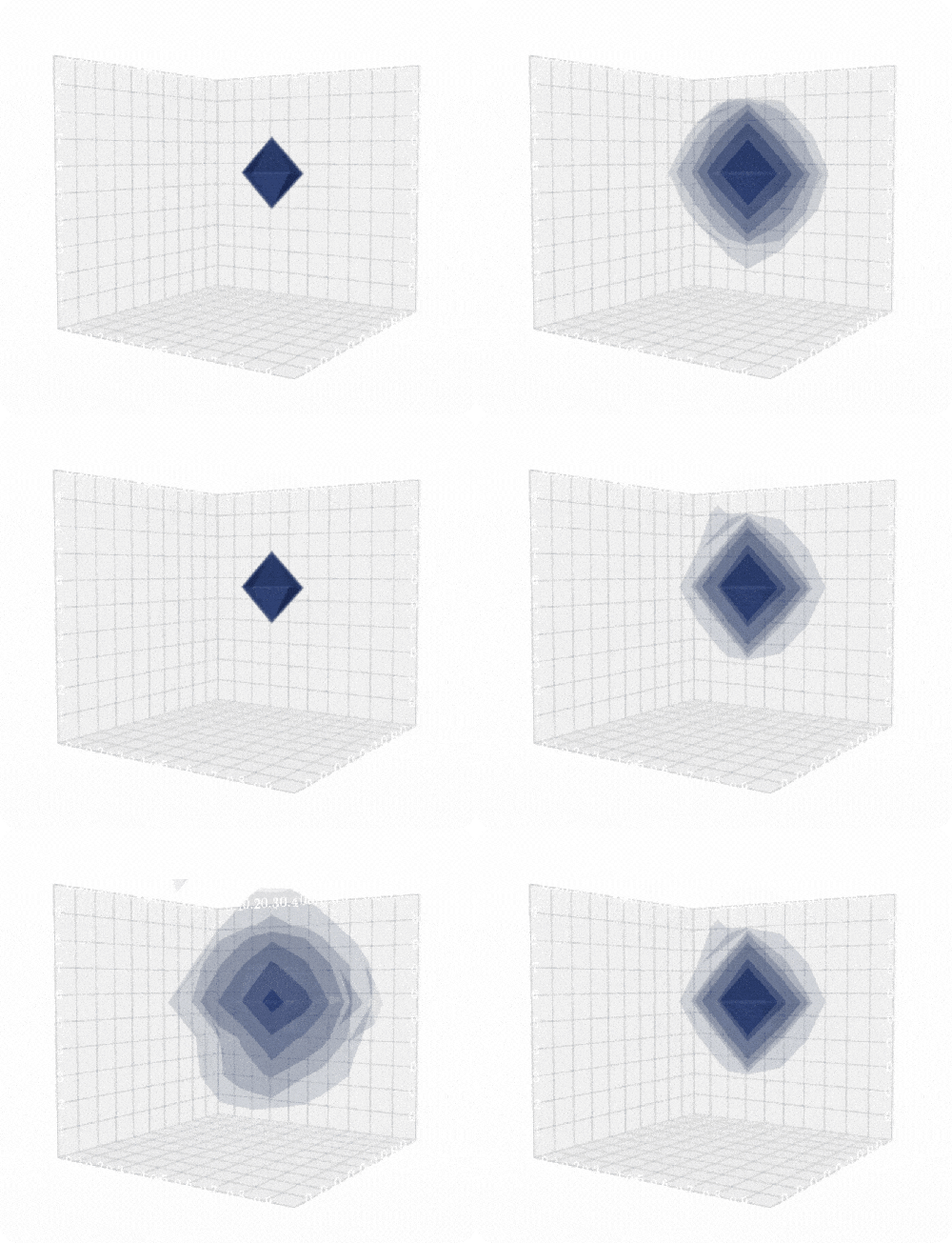
By transitioning from two-dimensional modeling to a full 3D spatial environment, we successfully encoded and evolved a diffusion problem that modeled the spread of a chemical contaminant within a body of water.


The approach

Moving to a 3D environment requires exponentially more data points, making hardware execution highly complex.

  • The simulation was deployed directly via the IQM Resonance cloud computing platform.

  • We utilized 15 highly stable qubits to mathematically represent an 8x8x8 spatial grid incorporating 27 discrete flow directions.

  • We relied heavily on our Quantum Lattice Boltzmann Method (QLBM) applied to a 3D lattice structure.

  • We applied advanced error mitigation techniques designed specifically to preserve the delicate fidelity of the simulation across the complex 3D geometry as it evolved over time.

The impact

This demonstration decisively proves that high-fidelity 3D physics can be successfully compressed into a highly efficient quantum state.

  • It paves the way for modeling highly complex environmental scenarios, such as the spread of fire and smoke in urban skyscrapers or the precise dispersion of air pollutants.

  • It strongly validates that quantum computing can handle the geometric reality of physical products, leading to accurate digital prototypes that will eventually eliminate costly physical testing iterations.

4---3D-on-IQM
3D visualization of an advection-diffusion simulation, modeling the spread of a contaminant. This marks the first time a three-dimensional diffusion problem has been successfully evolved on a superconducting quantum chip.