
PMUT sensor yield prediction
Predicting fabrication yield of PMUT sensors via Monte Carlo analysis

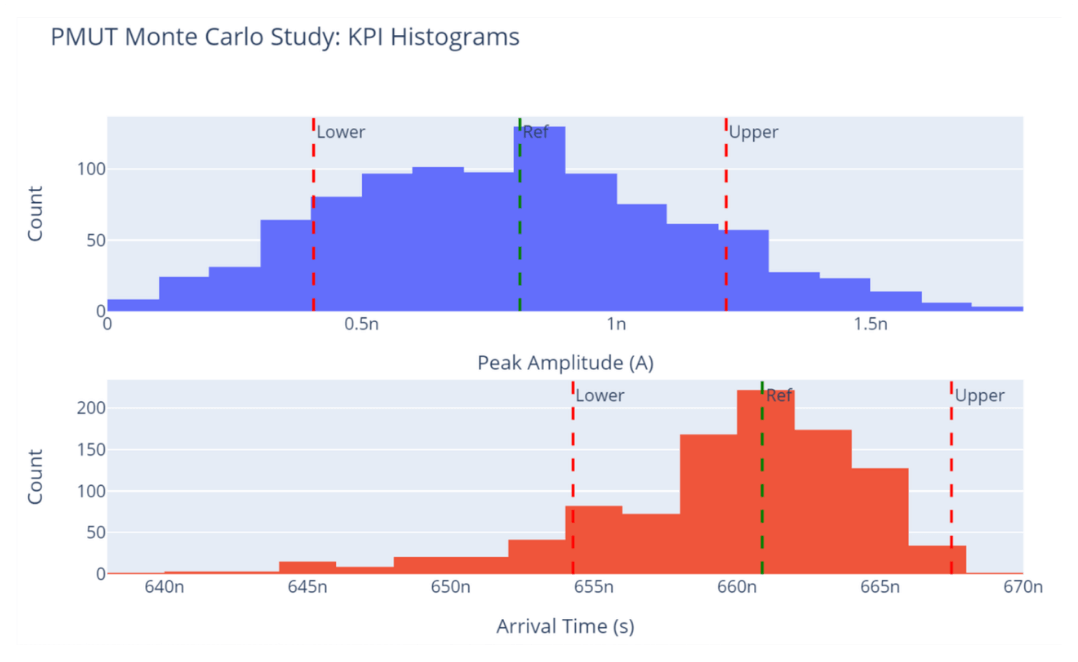
PMUT fingerprint sensors are highly sensitive to microscopic fabrication tolerances (e.g., layer thickness variations). Deterministic simulations cannot predict real-world manufacturing yield.
To ensure reliability, engineers need to simulate thousands of geometric variations (Monte Carlo analysis), which traditionally requires days of sequential computing time.
The study utilized Quanscient Allsolve’s cloud-native parallelization to run a Monte Carlo sweep of 1,000 randomized designs simultaneously.
The simulation involved strongly coupled multiphysics (Piezoelectric-Acoustic-Structure interaction) to capture the complex signal amplitude and arrival times for every single geometric variation.