
PMUT sensor generative design
Generative design of PMUT sensors via MultiphysicsAI & surrogate modeling
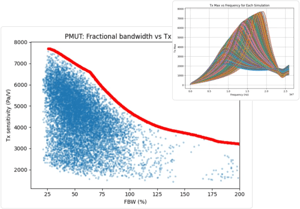
Electrostatics • Solid mechanics • Acoustic waves • Acoustic-Structure Interaction
The challenge
Designing PMUTs involves a difficult trade-off: improving Sensitivity usually degrades Bandwidth.
Finding the optimal balance (the Pareto Front) is an "Inverse Design" problem that traditionally requires weeks of manual trial-and-error. Engineers often settle for "good enough" because they cannot simulate enough variations to find the "best possible."
Approach with Quanscient Allsolve
Quanscient employed a "MultiphysicsAI" workflow:
- Generated a dataset of 10,000 parallel simulations in the cloud (varying 4 geometric parameters).
- Trained a Deep Neural Network (Surrogate Model) on this data.
- Used the AI to predict the performance of millions of design combinations in sub-milliseconds to identify the optimal geometry.
Key results
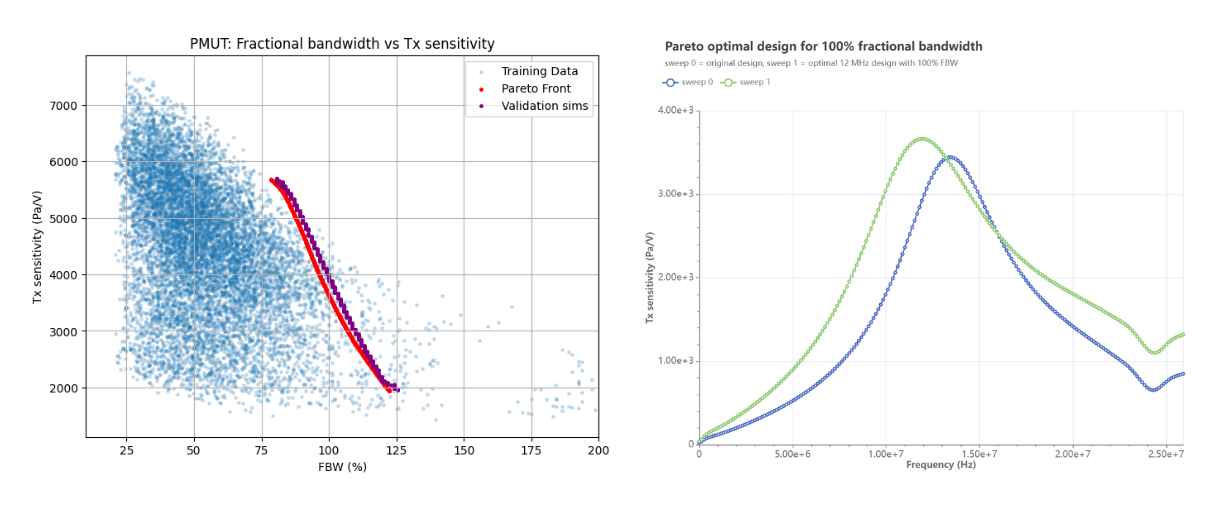
- Instant optimization: The AI Surrogate Model predicts complex physics outcomes in <1 millisecond with ~1% error, allowing the team to calculate the optimal Pareto Front in seconds.
- Performance breakthrough: Discovered a novel design that increased Fractional Bandwidth from 65% to ~100% while maintaining the target 12 MHz frequency.
- Workflow: Transformed the engineering process from "Guess and Check" to systematic, data-driven Inverse Design.
