.jpg?width=300&name=Cover%20image%20(1).jpg)
Authors
Jukka Knuutinen
Head of Marketing Quanscient
Key takeaways
- On 3 October 2026, Quanscient set a challenge at the Hack for Humanity hackathon in Tampere: build a web app that runs real physics simulations through the Allsolve SDK.
- Ten teams, mostly university students and none of them previous Allsolve users, took on the challenge.
- Using AI coding tools together with the Allsolve Agent and SDK, all ten teams had a working simulation app by the end of the afternoon.
- The winning team built a tool that designs patient-specific prosthetic socket liners by running 96 3D simulations in parallel in about a minute.
- Together, the projects show how quickly a custom simulation tool can be built on Allsolve, and how wide a range of engineering problems it can cover.
On Saturday 3 October, ten teams spent an afternoon at Tampere University building web apps on top of Quanscient Allsolve. None of them had used Allsolve before. By the 17:00 deadline, all ten had a working app that ran real physics simulations in the cloud and returned results a user could act on.
The event was Hack for Humanity: Finland edition, hosted by Tampere Entrepreneurship Society (TRES) and AI Collective. About 80 participants chose between three challenges. Ours filled first, and 10 teams of two to four people, about 30 participants in total, took it on.
%20(1).jpg?width=608&height=405&name=Hack%20for%20humanity%20blog%20(2)%20(1).jpg)
The teams working on their projects. © 2026 Santeri Hukari
The teams combined AI coding tools with the Allsolve SDK and the Allsolve Agent. Between 11:00 and 17:00 they had to pick a problem, build the app and prepare a pitch, which left roughly three to four hours of hands-on building.
The challenge
We asked teams to pick an example customer with an engineering problem and show how an Allsolve-powered app creates value for them. The app had to take user input, call Allsolve through the SDK, run a real simulation and return a result the user could act on. The physics had to do the work; a convincing number in a nice interface didn't count.
Teams got Allsolve access, an example web app (a beer-cooling simulation) and agent skills that teach AI coding tools how to work with the SDK. Mila Huovinen from our team was on site all day to answer questions.
We judged the challenge ourselves, scoring each pitch out of 10 on five criteria: impact, functionality, creativity, presentation and scalability. The top three finished one point apart, with 43, 42 and 41 points out of 50.
Winner: HolkkiLab, a prosthetic socket liner in minutes
.png?width=635&height=495&name=Nimet%C3%B6n%20malli%20(5).png)
The web app the HolkkiLab team built for prosthetists: enter a patient's measurements, and Allsolve finds the socket liner design that takes pressure off the limb tip.
HolkkiLab won with a tool that shortens one of the slowest steps in prosthetic care. It came from a two-person team with a medical background.
The socket joins the residual limb to the prosthesis, and it is shaped by hand over weeks of visits. If pressure at the tip of the limb is too high, the skin breaks down and the prosthesis goes unused. Skilled prosthetists are scarce, most of all where the need is greatest, such as among landmine and war amputees.
HolkkiLab is a web app for the prosthetist. Enter the patient's weight and limb measurements, and it returns a 3D-printing recipe for a socket liner with three stiffness zones.
.png?width=749&height=212&name=Nimet%C3%B6n%20malli%20(9).png)
Each dot is one simulated liner design. The app picks the one that relieves the limb tip most, almost a third less load than a conventional rigid socket, without letting the limb sink too deep.
Every candidate liner is a full 3D FEM simulation, run in parallel through the Allsolve SDK. In the team's demo case, an 80 kg patient, the app ran 96 simulations in 66 seconds. The best liner cut the load at the limb tip by 31%, from 29.4 to 20.3 kPa, for under 1 mm of extra sink.
The 2020 study the team built on (Steer et al.) reports about 30 minutes for a single simulation. The team found that run time stayed nearly flat from 27 to 216 liners, because Allsolve spreads a sweep across parallel cloud jobs. They also trained a surrogate model on their Allsolve results that suggests a liner in under a second, then checks it with 8 FEM runs.
The team was clear about the limits: a linear, static tissue model, simplified limb geometry, and no friction between limb and socket. They presented the output as a design proposal for the prosthetist, who still does the fitting. Next on their list would be a 3D scan of the patient's own limb, a more realistic tissue model, and a first printed liner tested at a prosthetics workshop.
Second place: ModalForge, footstep sounds from physics
.png?width=653&height=507&name=Nimet%C3%B6n%20malli%20(6).png)
ModalForge's footstep lab: pick a floor, shoe and room, walk across it in the browser, and hear sound generated from the floor's simulated vibration.
ModalForge generates footstep sounds by simulating the floor instead of playing back recordings. It took full marks for functionality and creativity, and only its impact score kept it from first place.
Pick a floor (pine, oak, garden deck, steel catwalk, glass or concrete) and walk across it in the browser. Allsolve solves how the floor structure vibrates in 3D, boards, joists and supports included. The browser turns those vibration modes into sound, so every step is unique and matches the floor, shoe, walker and room.
A draft-quality solve takes about two minutes, and each floor is cached once solved. The app can switch between a textbook plate model and the Allsolve result on the same step. The difference is audible: the 3D solve captures modes where the joists move with the boards, which the simple model can't produce.
The output drops straight into a production pipeline as WAV files, surround mixes, or sound packs for Unreal, Unity, FMOD and Wwise. The team's next idea reaches past games: letting architects hear a floor before it is built.
Third place: Touchstone, mid-air haptics from PMUT arrays
.png?width=795&height=342&name=Nimet%C3%B6n%20malli%20(8).png)
Touchstone lets engineers design a single PMUT cell and see how the full haptic array would perform before paying for a fab run.
Touchstone is a design tool for buttons you can feel in mid-air, built on the kind of MEMS design work Allsolve is made for. Car makers, XR companies and medical device makers want these buttons. The chips behind them are PMUT arrays: hundreds of tiny ultrasound transducers that focus pressure onto a fingertip.
Every new chip design costs a fab run, so Touchstone lets engineers test the design first. Allsolve simulates a single PMUT cell, coupling the piezoelectric film, silicon membrane, cavity and the air above it, in about two minutes. Touchstone then combines the cell results across a 225-element array to answer three questions: can people feel it, how loud is it at the ear, and where does the design hit its limits?
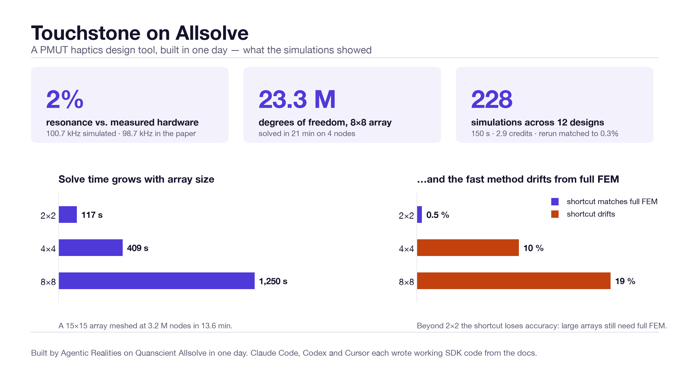
Touchstone's key results, compiled from the team's figures: the simulated chip matched real hardware within 2%, and 228 simulations across 12 designs ran in parallel in under three minutes.
To check the model, the team simulated a published chip (Xia et al., 2024) using only its published geometry and materials. The simulated resonance landed within 2% of the measured value. In one batch they ran 12 designs and 228 simulations in parallel in 2.5 minutes, and they solved an 8 × 8 array with 23 million unknowns on four machines in 21 minutes. They also tested where combining single-cell results stops holding: beyond 2 × 2 cells it drifts 10–19% from a full simulation of the array, so large arrays still need the full solve.
The team built Touchstone with three AI coding agents working on the SDK. They then packaged what the agents learned into an open agent skill that others can reuse.
The rest of the field
| Project | What it does | Physics |
|---|---|---|
| AllQuiet | Finds where acoustic screens cut speech noise at the desks of an open office. Users draw the room or trace a phone scan, and the app tests many layouts in parallel. | Room acoustics |
| BladeThaw | Tells wind farm operators whether to heat iced turbine blades now or wait, using local weather and the day-ahead electricity price. One finding: at −15 °C, heating a spinning rotor never frees the ice, while stopping it clears it in 11 minutes. | Transient heat transfer |
| Frost | Estimates whether water in an outdoor pipe freezes during a cold spell, and how insulation or a small drip flow changes the risk. | Transient heat transfer |
| CellShield | Compares PEM fuel cell bipolar plate channel designs for pressure loss and flow distribution. | Fluid flow |
| Optimimax | Predicts turbine blade deformation during machining and generates compensated geometry and machining parameters. | Structural mechanics |
| Solar cell soldering | Shows how soldering power and speed drive temperature and stress in silicon solar cells, to find settings that avoid microcracks. | Coupled thermal and mechanical |
What the day showed
-
First contact to working app in an afternoon. AI coding tools wrote most of the code, and the Allsolve Agent and SDK supplied the simulation engine underneath. That combination let a team with a medical background ship a 3D FEM optimization tool in a few hours, and every one of the ten teams got real simulations running.
-
Simulation inside your own app. Each team wrapped Allsolve in an interface built for one specific user: a prosthetist, a sound designer, a wind farm operator, someone planning an office. The same pattern works for engineering teams who want internal tools or configurators around their own problems, with the solver running underneath.
-
Range. The apps spanned structural mechanics, structural vibration, piezoelectric MEMS, room acoustics, transient heat transfer, fluid flow and coupled thermal-mechanical problems. They all ran on the same SDK, built in the same afternoon.
-
Parallel runs in the cloud. The strongest apps ran many variants at once: HolkkiLab ran 96 liners in 66 seconds, and Touchstone ran 228 simulations in 2.5 minutes. Running sweeps in parallel is what turned a single simulation into an optimization tool within a demo's time budget.
We also got a lot of good feedback on the SDK and how people use it, which helps us improve it further.
What's next
Ten teams new to Allsolve built working simulation apps in one afternoon. If you want to see what your own engineers could build on Allsolve, get in touch with us from the link below.
Read more about the Allsolve SDK ->
Thank you to TRES and AI Collective for hosting, and to every team that took on the challenge!