Choosing a MEMS simulation platform for nonlinear multiphysics analysis means weighing solver accuracy, cloud scalability, and yield prediction capabilities across a crowded market. Your R&D timeline depends on how fast you can run coupled simulations and how confidently you can predict manufacturing outcomes.
Quanscient Allsolve gives you cloud-native multiphysics simulation with built-in harmonic balance and parallel Monte Carlo analysis, cutting runtimes from days to minutes. This article compares six platforms so you can pick the right fit for your MEMS engineering workflow.
Disclosure: Quanscient develops Allsolve. Information on other platforms comes from each vendor's public documentation as of September 2026. Capabilities change often, so confirm details with the vendor.
Quick guide: 6 best MEMS simulation platforms for nonlinear multiphysics
- Quanscient Allsolve: The best cloud-native platform for nonlinear MEMS multiphysics and yield optimization
- COMSOL Multiphysics: Parametric MEMS modeling with coupled electro-mechanics and thermal domains
- Ansys (part of Synopsys): Coupled simulation workflows for electrostatics, structural mechanics, and piezoelectric effects
- Cadence: MEMS co-design methodology linking IC and device-level simulation
- Altair (part of Siemens): Structural optimization and nonlinear analysis for MEMS verification studies
- Siemens Simcenter: System-level MEMS design with CFD and conjugate heat transfer modeling
How we chose the best MEMS simulation platforms for nonlinear multiphysics
Picking the right MEMS simulation tool is about more than checking a feature list. You need to know whether a platform can handle coupled nonlinear physics, scale to thousands of parallel runs, and give you reliable yield data before tape-out.
Here is what we evaluated for each platform:
- Nonlinear solver capability: Can the platform solve steady-state nonlinear behavior directly, or does it force you through long transient runs?
- Multiphysics coupling depth: Does the solver natively couple structural, electrostatic, acoustic, and thermal physics, or do you need to stitch separate domain simulations together?
- Cloud scalability and parallel execution: Can you run hundreds or thousands of simulations simultaneously without hitting memory or license bottlenecks?
- Yield and tolerance analysis: Does the platform support Monte Carlo or parametric sweeps that let you map manufacturing variations to device performance?
- Automation and API access: Can you script and automate your simulation workflows with Python or other programming interfaces?
- Meshing quality for complex MEMS geometries: Does the mesher handle thin-film stacks, comb drives, and microacoustic cavities without manual intervention?
The 6 best MEMS simulation platforms for nonlinear multiphysics and yield optimization
1. Quanscient Allsolve: Best overall MEMS simulation platform for nonlinear multiphysics
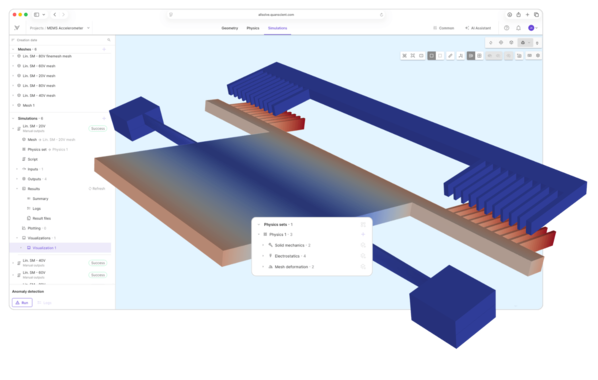
Quanscient Allsolve is a cloud-native multiphysics simulation platform built to handle the most demanding MEMS engineering challenges. Its proprietary solver natively couples structural mechanics, electrostatics, acoustics, and thermal physics in a single model, eliminating the need for simplified domain-by-domain approaches.
What sets Quanscient Allsolve apart is the harmonic balance method, which solves nonlinear steady-state problems directly in the frequency domain. For MEMS microspeakers, RF filters, and resonators, this means you get accurate higher-harmonic data and total harmonic distortion metrics without running long, noisy transient simulations.
On the yield side, Quanscient Allsolve runs thousands of simulations in parallel on cloud infrastructure. A Monte Carlo analysis of 1,000 PMUT variations completed in just 15 minutes using 1,000 cores, predicting a 71.9% manufacturing yield against predefined performance thresholds. For microspeakers, 12,500 nonlinear harmonic balance simulations ran in about 20 minutes to train a MultiphysicsAI surrogate model, which predicted a 72% yield across manufacturing tolerances.
Quanscient Allsolve features
- Harmonic balance for nonlinear MEMS: Solves coupled fluid-structure-electrostatics in the frequency domain, capturing geometric nonlinearity and higher-order harmonics for metrics like THD
- Cloud-scale parallel execution: Runs thousands of coupled multiphysics simulations simultaneously, running large batches in parallel (in our PMUT example, 1,000 runs in 15 minutes vs. an estimated 66 hours sequentially)
- Monte Carlo yield estimation: Maps manufacturing variations to device performance using statistically significant sample sizes, with pass/fail criteria for quantitative yield assessment
- MultiphysicsAI surrogate modeling: Trains physics-aware neural networks on your simulation data to predict performance in milliseconds, enabling real-time design space exploration
- Python-native automation: Full GUI parity in Python scripting with JSON/YAML project definitions, so you can integrate simulations into existing engineering pipelines
- Natively coupled multiphysics: Structural, electrostatic, acoustic, piezoelectric, and thermal physics are coupled at the algorithm level
Quanscient Allsolve pros and cons
Pros:
- Harmonic balance method eliminates the need for slow transient runs when analyzing nonlinear MEMS behavior
- Cloud infrastructure removes memory and core-count limitations, letting you scale models that would crash on a desktop workstation
- Unlimited users and no per-seat license restrictions, so your whole team can simulate simultaneously
Cons:
- As a cloud-only platform, an internet connection is required to run simulations
- The platform is newer to the market compared to some legacy tools, so the community forum is still growing
- Some niche physics modules available in older platforms may not yet be covered
2. COMSOL Multiphysics®: Parametric sweeps for coupled MEMS domains
COMSOL Multiphysics® supports coupled electro-mechanics, thermal, and fluid simulations for MEMS devices using physics-controlled meshing and parametric studies. The platform includes a dedicated MEMS Module that adds piezoelectric, electrostatic, and thin-film flow models to the base package.
Its parametric sweep capability lets you define geometry and material parameters, then run systematic studies to track how design changes affect device behavior. Model organization captures geometry, solver settings, and boundary conditions in a single project file for reproducibility.
COMSOL Multiphysics features
- MEMS Module with piezoelectric and electrostatic physics: Adds domain-specific interfaces for common MEMS device types including accelerometers, gyroscopes, and resonators
- Parametric studies and sweeps: Runs automated studies across geometry, material, and operating condition parameters with saved model states
- Physics-controlled meshing: Adapts mesh density based on the active physics interfaces, reducing manual mesh configuration for coupled problems
COMSOL Multiphysics pros and cons
Pros:
- Broad physics coverage across structural, electromagnetic, thermal, and fluidic domains in one interface
- Parametric studies produce repeatable baselines for design verification
- Large user community and established documentation for MEMS-specific workflows
Cons:
- Cluster and cloud runs require a floating network license and a cluster or cloud environment you set up
- Per COMSOL's documentation, its Frequency Domain study computes linear or linearized responses, so fully nonlinear harmonic responses are solved in the time domain, which can lengthen runtimes
- Large Monte Carlo studies use the add-on Uncertainty Quantification Module, which relies on surrogate models to keep computation affordable
3. Ansys (part of Synopsys): Coupled MEMS simulation in a unified design environment
Ansys, part of Synopsys since July 2025, offers offers MEMS-focused simulation through its Mechanical and Electronics Desktop products, combining electrostatic, structural, fluid, and piezoelectric analysis in project-based workflows. The platform supports electromechanical circuit simulation and prestressed coupled-field modal analysis for MEMS resonators and sensors.
Its system coupling capabilities connect separate physics solvers for co-simulation, which is useful when your device involves interactions between domains that need distinct discretization approaches.
Ansys features
- Electromechanical co-simulation: Couples electrostatic and structural solvers for MEMS switches, actuators, and capacitive sensors
- Coupled-field modal analysis: Runs prestressed modal analysis to capture frequency behavior under bias conditions for resonators and filters
- Project-based multiphysics management: Keeps model setup, meshing, and solver configurations aligned for traceability across design iterations
Ansys pros and cons
Pros:
- Mature solver technology with decades of validation across MEMS device types
- Project-based workspace ties model setup, meshing, and results to reproducible configurations
- Broad ecosystem of add-on modules covering acoustics, electromagnetics, and thermal analysis
Cons:
- Some physics combinations run as co-simulations between separate solvers (via System Coupling) rather than in a single solver
- Its harmonic balance method is documented for structural dynamics with localized nonlinearities such as contact and friction (Ansys HBM Analysis Guide)
4. Cadence: MEMS co-design linking IC and device simulation
In February 2026, Cadence completed its acquisition of Hexagon's Design & Engineering business, adding MSC Nastran and Adams to its multiphysics portfolio.
Cadence supports MEMS design through a co-design methodology that connects IC-level circuit simulation with device-level finite element modeling. This approach is oriented toward RF MEMS and sensor designs where the interface between the MEMS device and its readout electronics matters.
The platform uses Verilog-A behavioral models and macro-models to represent MEMS devices inside circuit simulation environments, letting you verify system-level performance before committing to fabrication.
Cadence features
- MEMS co-design methodology: Bridges device-level FEA with IC circuit simulation for integrated MEMS-plus-electronics verification
- Verilog-A behavioral modeling: Represents MEMS device behavior as circuit-compatible models for system-level performance checks
- RF MEMS switch modeling: Supports large-signal models for ohmic and capacitive RF MEMS switches in circuit environments
- Spectre FMC Analysis: ML-assisted Monte Carlo yield analysis for circuits, distributable across compute farms or the cloud
Cadence pros and cons
Pros:
- Tight integration between MEMS device models and IC circuit simulation tools
- Verilog-A models let you verify MEMS-plus-electronics performance at the system level
- Useful for RF MEMS designs where device-circuit interaction is a primary concern
Cons:
- The MEMS co-design flow is oriented toward device–circuit co-verification; device-level nonlinear multiphysics coverage depends on which Cadence tools you combine
5. Altair: Structural optimization for MEMS verification
Altair, acquired by Siemens in March 2025, offers MEMS-relevant simulation through OptiStruct and its broader HyperWorks suite, focusing on structural analysis, topology optimization, and piezoelectric modeling. The platform includes nonlinear structural solvers and fluid-structure interaction capabilities that apply to MEMS actuator and sensor designs.
Its optimization workflows couple finite element results with topology and parameter objectives, which is relevant when you need to minimize mass or maximize stiffness in a MEMS structure under specific performance constraints.
Altair features
- Topology optimization: Optimizes MEMS geometry based on structural performance objectives and manufacturing constraints
- Piezoelectric analysis: Models electromechanical coupling in piezoelectric MEMS transducers and actuators
- Fluid-structure interaction: Couples fluid flow with structural deformation for MEMS devices involving microfluidic or acoustic cavities
Altair pros and cons
Pros:
- Optimization-driven workflows help you reach performance targets with fewer manual iterations
- Nonlinear structural analysis handles large-deformation MEMS problems
- Input decks support reproducible baselines for verification evidence
Cons:
- Positioned as general-purpose structural and optimization software rather than a MEMS-specific tool
6. Siemens Simcenter: System-level MEMS with CFD and thermal modeling
Siemens Simcenter covers MEMS simulation through a combination of Simcenter STAR-CCM+ for CFD and thermal analysis and the broader Simcenter portfolio for system-level modeling. The platform supports microscale fluid and thermal behavior relevant to MEMS packaging, squeeze-film damping, and thermal management.
Its system-level MEMS design approach uses reduced-order models and behavioral modeling to connect device-level physics with circuit and system simulation, which is relevant for teams working on sensor systems that need end-to-end performance predictions.
Siemens Simcenter features
- CFD for microscale flows: Simulates squeeze-film damping, microfluidic channels, and conjugate heat transfer at MEMS scales
- System-level MEMS modeling: Connects device physics to system performance using reduced-order models and behavioral abstractions
- Scripted simulation templates: Automates study runs with repeatable configurations for batch execution and parameter sweeps
Siemens Simcenter pros and cons
Pros:
- CFD capabilities cover microfluidic and thermal MEMS behaviors that some structural-only tools miss
- System-level modeling connects MEMS device physics to full product performance
- Scripted workflows support repeatable configurations across design iterations
Cons:
- MEMS workflows typically combine several Simcenter products (for example, STAR-CCM+ for CFD and thermal, HEEDS for design exploration)
How does nonlinear simulation improve MEMS device performance?
MEMS devices like microspeakers, RF filters, and inertial sensors operate in regimes where material and geometric nonlinearities affect real-world performance. Linear models miss these effects, which means your simulation results may not match what comes off the fabrication line.
Nonlinear simulation captures how large deflections, contact mechanics, and electrostatic pull-in change device behavior under actual operating conditions. For microspeakers, this means accurately predicting sound pressure level and total harmonic distortion across the audible frequency range.
The harmonic balance approach is particularly useful here because it solves directly for the steady-state periodic response. Instead of running a transient simulation for thousands of cycles until the system settles, you get the answer in a fraction of the time with cleaner data and fewer numerical artifacts.
Why does manufacturing yield prediction matter for MEMS engineering teams?
MEMS fabrication involves thin-film deposition, etching, and lithography steps that introduce dimensional and material variations from wafer to wafer. If your simulation assumes perfect geometry, you are designing for a device that does not exist in production.
Monte Carlo simulation applies random variations to key parameters like layer thicknesses, material properties, and etch depths, then evaluates how each combination affects device performance. Running these studies at scale, with hundreds or thousands of samples, gives you statistically meaningful yield predictions.
This data tells you which parameters matter most, where your design margins are thin, and how to adjust tolerances to hit your target yield.
Why Quanscient Allsolve is the best MEMS simulation platform for nonlinear multiphysics
When your engineering team needs to run nonlinear multiphysics simulations at scale, Quanscient Allsolve combines harmonic balance for coupled nonlinear multiphysics with cloud-scale parallel execution in one platform. Harmonic balance solves nonlinear MEMS problems directly in the frequency domain, giving you accurate steady-state results, including higher-order harmonics, without the runtime penalty of transient analysis.
Quanscient Allsolve runs your simulations on cloud infrastructure with on-demand memory and cores. In our published examples, that meant 12,500 nonlinear harmonic balance simulations in about 20 minutes and 1,000 Monte Carlo samples in 15 minutes.
Combined with MultiphysicsAI for millisecond-speed design space exploration and a Python-native API for full workflow automation, Quanscient Allsolve gives you the complete toolchain for MEMS design, optimization, and yield analysis. Book a demo to see how it fits your specific engineering challenges.
FAQs about MEMS simulation platforms for nonlinear multiphysics
What is harmonic balance and why does it matter for MEMS simulation?
Harmonic balance is a frequency-domain method that solves for the steady-state periodic response of nonlinear systems. Quanscient Allsolve uses it to capture higher-order harmonics and total harmonic distortion in MEMS devices like microspeakers and RF filters, without running long transient simulations to reach steady state.
How many simulations can you run in parallel for MEMS yield estimation?
Quanscient Allsolve runs thousands of simulations simultaneously on cloud infrastructure. In documented examples, 1,000 PMUT Monte Carlo variations completed in 15 minutes and 12,500 microspeaker simulations finished in about 20 minutes, giving you statistically meaningful yield data fast.
Can I automate MEMS simulation workflows with Python?
Yes. Quanscient Allsolve has full GUI parity in Python, letting you define projects in JSON or YAML, script parameter sweeps, and integrate simulations into your existing engineering pipelines. LLM agents can also run simulations from natural-language prompts through the API.
What types of MEMS devices benefit most from nonlinear multiphysics simulation?
Devices with large deflections, electrostatic pull-in, or acoustic-structural coupling benefit the most. This includes microspeakers, RF MEMS switches, piezoelectric ultrasound transducers (PMUTs and CMUTs), gyroscopes, and accelerometers where linear models miss critical performance effects.
How does MultiphysicsAI speed up MEMS design exploration?
MultiphysicsAI trains physics-aware neural networks on your simulation data to predict device performance in milliseconds. You can screen hundreds of thousands of design candidates instantly, identify the best trade-offs, then validate finalists with full multiphysics simulations in Quanscient Allsolve.
COMSOL Multiphysics is a registered trademark of COMSOL AB. All other product names are trademarks of their respective owners. Quanscient is not affiliated with or endorsed by these companies.