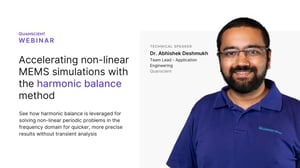
Accelerating nonlinear MEMS simulations with the harmonic balance method
See how harmonic balance is leveraged for solving nonlinear periodic problems in frequency domain for quicker, more precise results without transient analysis.
From a research paper to a working simulation app in one afternoon
The winners of our Hack for Humanity challenge on building a prosthetic socket design tool on Allsolve with no prior simulation experience.
Introduction to the guests
Niko Matela and Sakari Hervonen are students at Tampere University and the winners of Quanscient's challenge at the Hack for Humanity hackathon. Niko studies medicine alongside industrial engineering and management. Sakari studies industrial engineering and management, between his bachelor's and master's. It was the first hackathon for both.
In this episode...
We talk with the team behind HolkkiLab, the app that won our challenge at Hack for Humanity in Tampere: enter a patient's measurements, and it runs a batch of 3D socket liner simulations in parallel on Allsolve to find the design that takes the most load off the limb tip.
We cover how they found the problem, how they scoped it to something simulation could actually answer, how they used AI coding tools to go from a research paper to running physics in a few hours, and what they would build with one more day.
A prosthetic socket is shaped by hand over weeks of visits, and if pressure at the tip of the residual limb is too high, the skin breaks down and the prosthesis goes unused.
A web app for the prosthetist: enter the patient's weight and limb measurements, and it returns the socket liner design that relieves the limb tip the most.
The study they built on reports around 30 minutes for a single simulation; their app runs 216 full 3D simulations in parallel in about 90 seconds.
Running the whole design sweep at once is what makes the tool usable inside a patient visit rather than as an overnight job.
Their original idea was cold chain transport for vaccines and insulin; after talking to our team they reframed the search around computationally heavy optimization problems.
Of a six-hour window, roughly half went into understanding the problem and the model's limits before any simulation was run.
With a clear problem and a clear goal, their work was mostly in framing the right prompts; the physics and the geometry script came out of AI coding tools.
Their 90-second target was self-imposed for the demo, and the next step would be a far larger parameter sweep over the design space.
Watch the full episode on YouTube
0:00 Intro: the hackathon and HolkkiLab
2:10 Meet Niko and Sakari
3:21 Why they joined the hackathon
5:23 First impressions of the Allsolve challenge
7:10 Their background in simulation
8:40 From vaccine logistics to prosthetic sockets
9:50 30 minutes per simulation vs. 216 in 90 seconds
12:31 Simulating without prior expertise
15:20 How they used AI to build the app
16:50 Was the Allsolve SDK easy to use?
18:11 The GUI and the Allsolve Agent
20:55 What they'd build with one more day
24:04 Bonus: the prize money
What 30 first-time users built with the Allsolve SDK in six hours
The full story of the hackathon: all ten teams, the three winning apps, and what an afternoon on the Allsolve SDK produced.