
SiC power card design optimization
Surrogate-driven multi-objective design of a double-sided cooled SiC power card, verified in FEM
Heat transfer • Solid mechanics • Viscoelasticity • Thermo-mechanical coupling
The challenge
Double-sided cooled SiC power cards fail in two competing ways: fatigue of the sintered-silver attach under the copper spacer, and tensile fracture of the ceramic substrate. Thicker copper protects the attach but loads the ceramic; thicker ceramic does the reverse.
Inside a fixed card-thickness budget every millimetre is a trade-off, and each candidate needs a transient thermo-mechanical simulation through several power cycles with viscoelastic attaches. Mapping that trade-off one design at a time is too slow to drive design decisions.
Approach with Quanscient Allsolve
A Latin hypercube of 300 designs over seven variables was submitted as a single Allsolve sweep. Each sample is a 3D thermo-mechanical model with Prony-series viscoelastic sintered-silver attaches, run through three pulsed power cycles.
A Gaussian-process surrogate per output fed an NSGA-II search for the Pareto front between attach damage and ceramic stress, under limits on die temperature, die stress, warpage and card thickness. Every design on the front was then rerun in FEM to verify it.
Key results
- 300 FEM designs in 402 s: The full training dataset ran as one parallel sweep on 2,411 cores.
- Verified within 0.4%: Sixteen Pareto-front designs, none in the training set, rerun in FEM matched the surrogate within 0.4%, all within constraints.
- Better and thinner than the baseline: The 3.0 mm front cuts attach energy per cycle from 104 to 63–85 kJ/m³ and ceramic stress from 187 to 140–173 MPa.
- 99% yield at a 6% cost: A 10,000-draw tolerance Monte Carlo showed that backing off the temperature limit lifts yield from 48% to 99% for about 6% of ceramic stress.
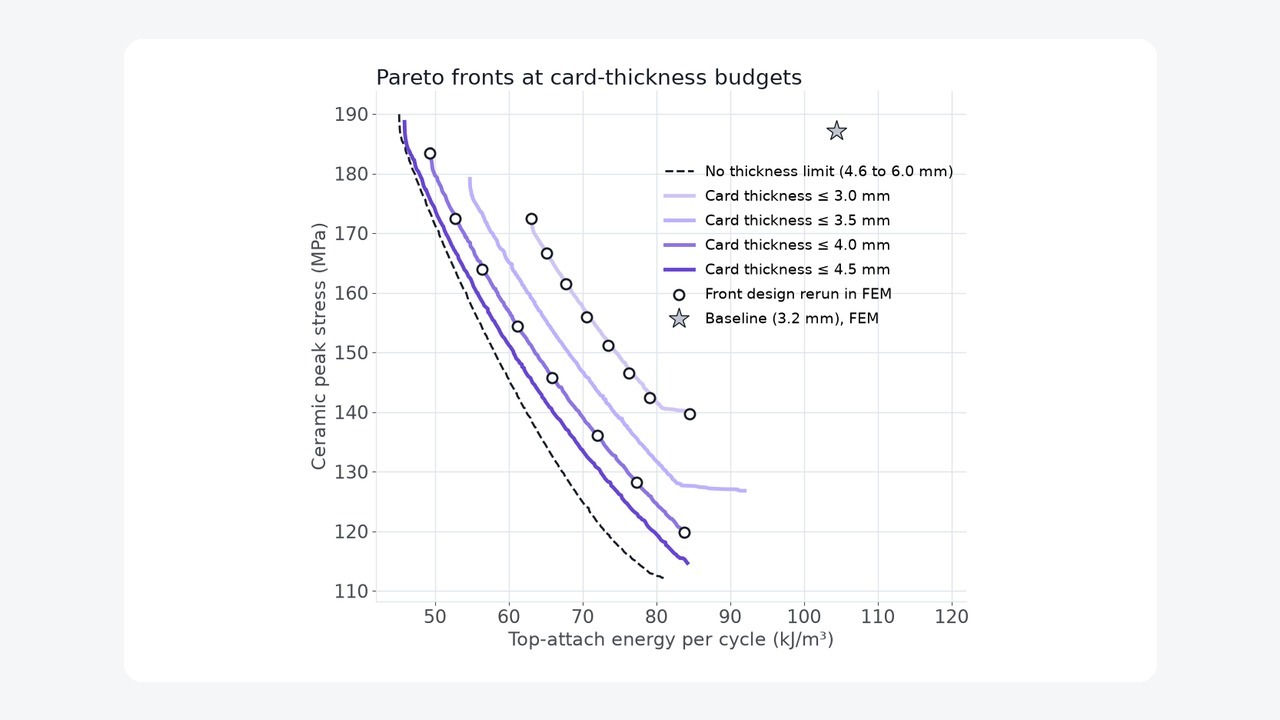
Pareto fronts at four card-thickness budgets. Top: attach energy against ceramic stress. Bottom: copper and ceramic thickness along each front. Open circles are designs rerun in FEM.