
Patch antenna design & yield
Designing and tolerancing a patch antenna via surrogate-assisted simulation (42 runs)
A microstrip patch antenna must resonate at 2.36 GHz with as deep an impedance match as practical, with patch length and width as the only free variables.
Each candidate is a 1.6M DoF full-wave solve, about two minutes of runtime. Sweeping the design box at 0.1 mm resolution would need ~30,000 designs, roughly 13 days, against a practical budget of 40 simulations.
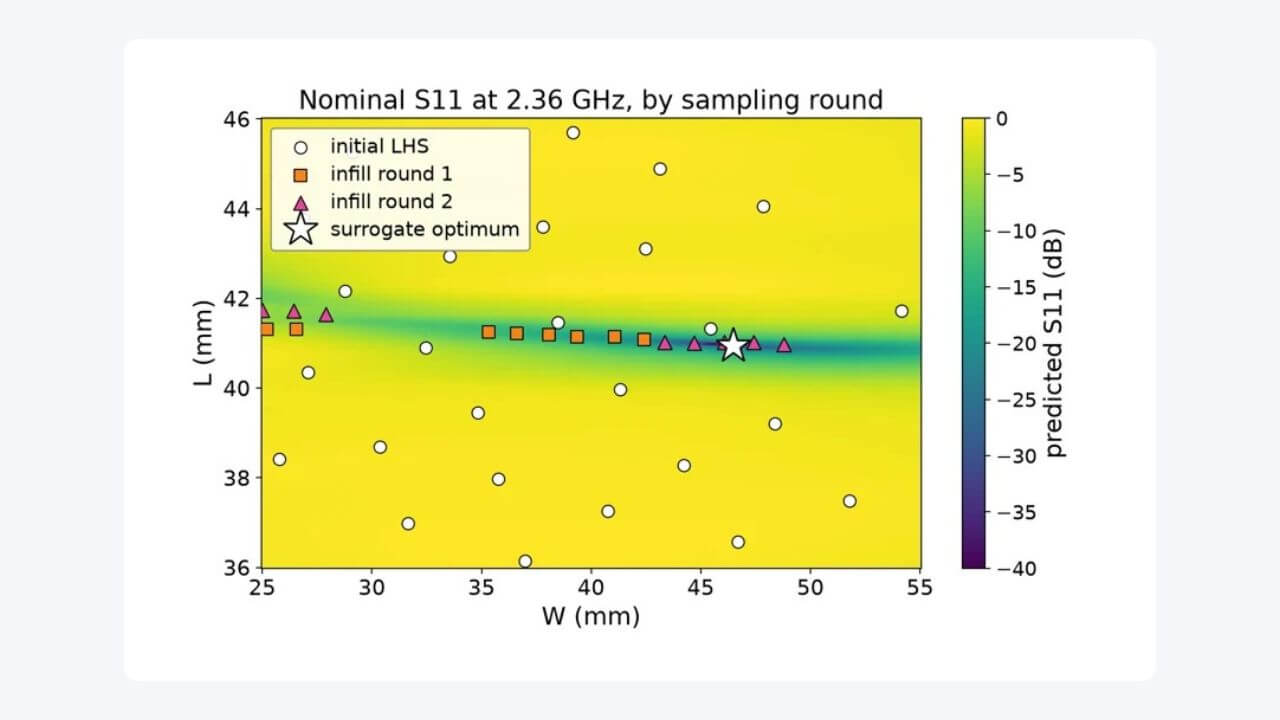
Quanscient Allsolve ran 30 Latin-hypercube designs concurrently to fit a first Gaussian process surrogate, which returns an uncertainty estimate with every prediction.
Infill rounds then added solves along the narrow resonance ridge the surrogate exposed. The optimum was read off the fitted surface and certified with the full-wave solver: 42 usable simulations, ~25 minutes.