
MEMS speaker yield optimization
Optimizing MEMS microspeaker yield & audio quality via MultiphysicsAI
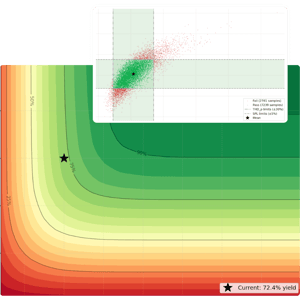
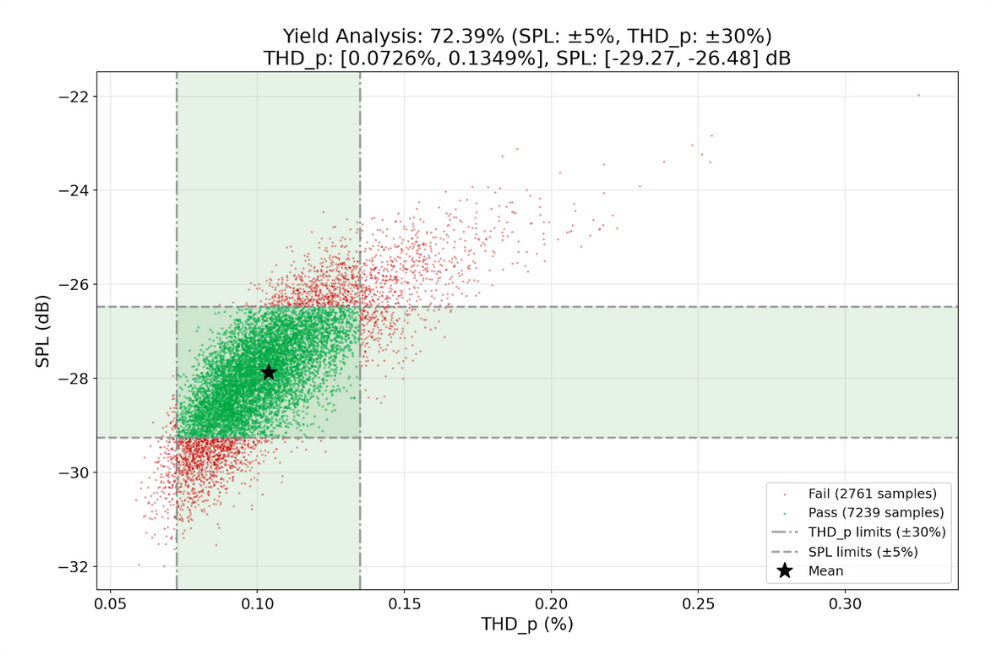
Silicon-based MEMS speakers face a difficult trade-off: driving them harder increases volume (SPL) but introduces Harmonic Distortion (THD) due to nonlinear electrostatic effects.
Furthermore, microscopic manufacturing variations (tolerances of ±10%) can ruin performance. Traditional simulation is too slow to map these thousands of failure scenarios.
The team performed a Nonlinear Harmonic Balance analysis on the cloud, generating 12,500 simulations in just 20 minutes.
This data trained an AI Surrogate Model which performed a Monte Carlo analysis, predicting how manufacturing tolerances would affect the final production yield.