Q-factor is where simulation and measurement part ways
A gyroscope's performance is set by how it loses energy, and those loss mechanisms are coupled. Model them separately, or on a tool that can't scale to the next-generation design, and the Q-factor you predict won't be the one you measure.
ROM tools hit a ceiling
A reduced-order model handles today's device but can't capture the mode coupling of the next-generation design. The limit only shows up once you're designing it.
Air gaps mean re-meshing
Adding or changing an air gap in a general FEM tool can force a full re-mesh, costing days of work every time the geometry moves.
Damping solved in pieces
Anchor loss, squeeze-film, and thermoelastic damping run separately, so their combined effect on Q-factor is never captured.
The fab decision rests on a guess
With a Q-factor you don't fully trust, the commitment to fabrication is made on a model that doesn't match the bench.
Every loss mechanism in one coupled model
Mechanical, thermal, and fluid physics coupled in a single model, run across geometry and pressure on the cloud and driven from your own scripts.
All damping, solved together
Anchor loss, squeeze-film, and thermoelastic damping in one coupled model. The Q-factor you predict reflects how the device loses energy.
Q-factor and modes, directly
Dedicated eigenfrequency analysis extracts natural frequencies, mode shapes, and quality factors straight from the model, with no frequency sweep needed.
Sweeps at cloud scale
Explore beam width, proof-mass geometry, and ambient pressure across many variants efficiently in the cloud, scripted once in the Python SDK.
What that makes possible
A coupled damping study on a real gyroscope, at a scale impractical for a single workstation.
50%
Q-factor error corrected
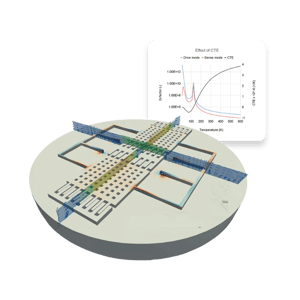
A fully coupled mechanical–thermal–fluid model corrected a 50% Q-factor error by capturing squeeze-film damping across temperature, the loss mechanism single-physics models miss.
10 min
For a 2.4M-DOF coupled solve
That full mechanical–thermal–fluid solve, at 2.4 million degrees of freedom, ran in 10 minutes on the cloud, so anchor loss, squeeze-film, and thermoelastic damping are explored together across sweeps, not one static design at a time.
Every avoided prototype run pays for the tool
Automotive and consumer inertial sensors ship at huge volume, but each new device still runs the full MEMS development path first. A medium-complexity device runs to a minimum of ~$4M in engineering budget over roughly four years. Every geometry and damping question you settle in simulation instead of silicon takes cost and months out of that path.
Source: Fitzgerald, White & Chung, "MEMS Product Development: From Concept to Commercialization" (Springer), Ch. 3, Table 3.2.
$1.5M
Minimum engineering budget for the advanced-prototype stage alone, for a medium-complexity MEMS device.~4 years
Typical span from proof-of-concept to foundry pilot production — each fab-dependent stage is roughly a year.$4M
Minimum total engineering budget across the four development stages, before overhead or capital expenses.Case examples and other resources
Webinar + PDF summary
Fully coupled MEMS simulation at scale: 3D FBAR & gyros
Download the summary on running fully coupled MEMS simulations and 3D parametric sweeps on gyroscopes with Quanscient Allsolve.
Download PDF summary →
Technical example
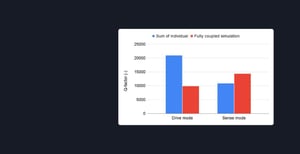
Predicting real-world gyroscope performance via coupled damping
A coupled damping analysis that corrected a 50% Q-factor error by capturing squeeze-film damping across temperature.
Open the example →
Case example
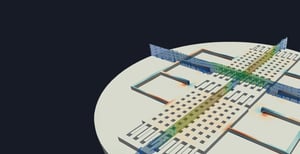
Fully coupled MEMS gyroscope simulations with Allsolve
How anchor loss, squeeze-film, and thermoelastic damping combine in one model to predict a gyroscope's real Q-factor.
Read the full article →

Inertial MEMS simulation questions
Can Allsolve simulate all the damping mechanisms in a gyroscope at once?
Why doesn't my Q-factor simulation match measurement?
Does it capture squeeze-film damping in the air gap?
Can I run geometry and pressure sweeps efficiently?
Can it extract eigenfrequencies and Q-factor directly?
Does it handle accelerometers as well as gyroscopes?
Does it fit a Python or scripted workflow?
See how it could work for you
Submit the form to talk with our experts—we'll respond within 1 business day. You'll learn:
- How Allsolve could fit your use case
- What results to expect (accuracy, runtime, design exploration capabilities and rough cost range)
- How it could plug into your workflow today
Interested in just seeing an on-demand demo? Watch the 3-minute demo here