
Micromirror 2:1 modal coupling
Tuning and resolving 2:1 tilt–piston coupling in an electrostatic micromirror with full 3D harmonic balance
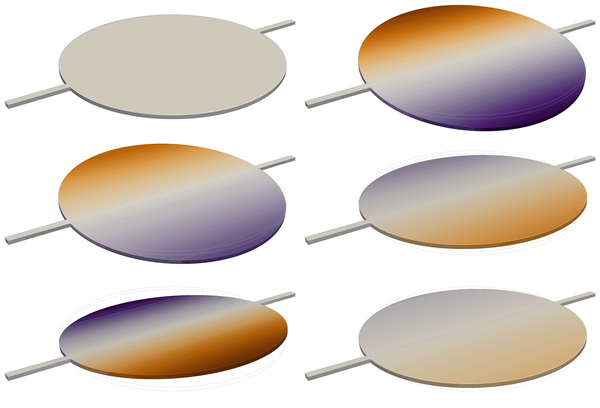
A 600 µm silicon micromirror on two torsion beams sits 3 µm above a drive and a sense electrode. The electrostatic force grows with 1/gap², so a tilt at frequency f also pushes the mirror at 2f.
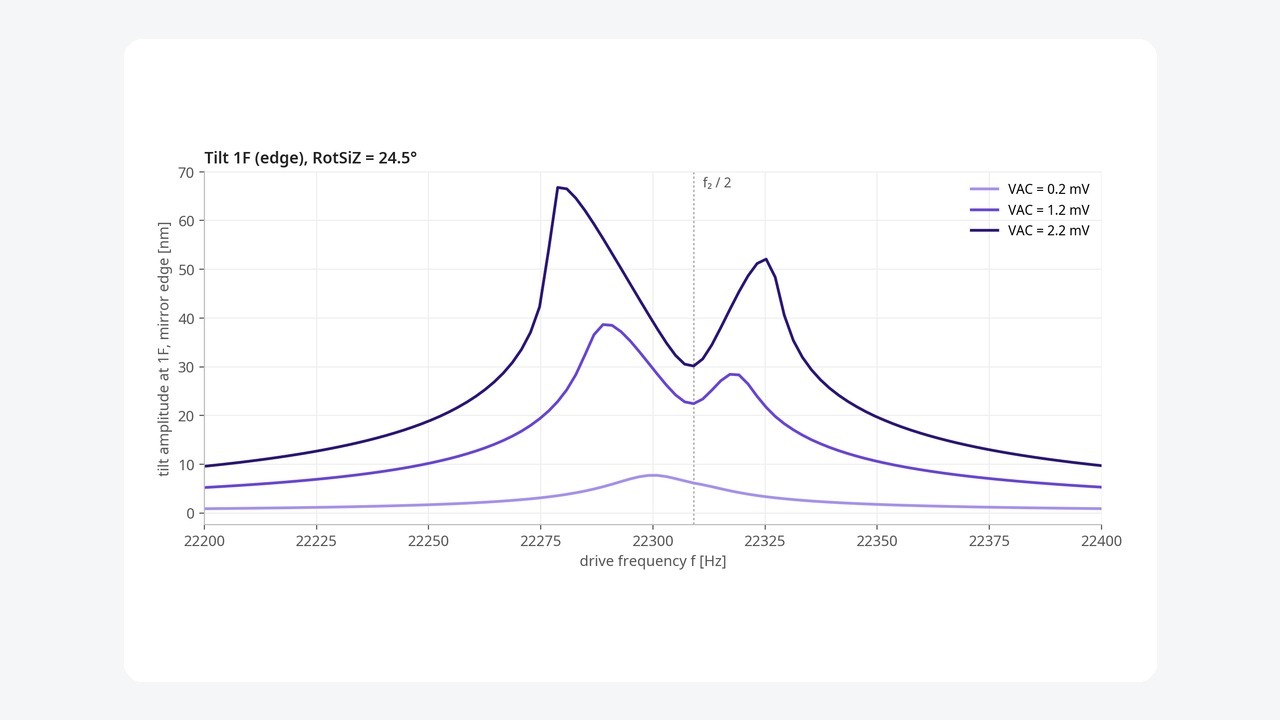
When the piston mode sits at twice the tilt frequency, the two modes exchange energy and the tilt resonance splits. Whether a design lands on that 2:1 condition depends on the crystal orientation and the DC bias, and linear eigenmode analysis cannot show what happens once it does.
An eigenmode sweep over 46 in-plane crystal angles of the anisotropic silicon found where the piston mode reaches twice the tilt frequency: 13.9° without bias and 24.5° at 20 V DC.
The mirror was then solved with full 3D harmonic balance (DC, 1F and 2F) on a gap mesh that follows the moving mirror, with Newton iterations on the analytic electromechanical Jacobian and one solve per frequency point. The sensed current was read from the charge on the sense electrode.
Tilt amplitude at the mirror edge versus drive frequency at a 24.5° crystal angle, for three drive levels. Near half the piston frequency the tilt saturates and the resonance splits.