.png?width=300&name=Copy%20of%20Blog%20image%20template%20(1).png)
Introduction
For decades, multiphysics simulation has been the domain of a small group of specialists. The tools were built to answer one question: "What happens if I build this design?" The engineer defines the geometry, applies boundary conditions, and waits, sometimes hours, sometimes days, for the solver to produce an answer. Then the cycle repeats.
This model has a fundamental problem. It is not a design exploration tool. It is a verification tool. And in a world where the competitive advantage belongs to the team that finds the best design, not just a working design, verification alone is not enough.
Quanscient MultiphysicsAI changes the question. Instead of asking what a given design does, it asks: "What design should we create?" That shift , from analysis to discovery, is the foundation of everything that follows.
What is MultiphysicsAI?
MultiphysicsAI is a workflow methodology for training physics-aware AI models that are ready to support your organization from innovation through to R&D and sales. It is not a standalone software product. It is a structured process that combines two things Quanscient does exceptionally well: generating large volumes of high-quality, natively coupled multiphysics simulation data with Quanscient Allsolve, and using that data to train AI surrogate models that understand the relationship between design variables and performance outcomes.
The result is a model that can execute product performance predictions at over 100,000 evaluations per second, while remaining grounded in the physics that produced its training data.
That is not a marginal speedup over classical simulation. It is a different class of tool entirely.
How the workflow works
The MultiphysicsAI workflow follows a clear sequence. First, Quanscient Allsolve generates a large, proprietary dataset of multiphysics simulations, typically thousands of runs with randomized geometric and material variants. This data becomes the ground truth for the AI model: a record of how design choices translate into physical performance.
Second, a surrogate model is trained on that dataset. The model learns the mapping between inputs and outputs, capturing nonlinear interactions and coupled physical effects that simpler analytical models cannot represent. Training a surrogate takes minutes, not days.
Third, the trained surrogate is deployed for design space exploration. Because predictions execute in milliseconds, it becomes feasible to screen hundreds of thousands of design candidates, compute Pareto fronts across competing objectives, run manufacturing tolerance analyses, or solve inverse problems, where you specify the performance target and ask the model to find the geometric parameters that achieve it.
Finally, the top candidates identified by the surrogate are brought back into Allsolve for full high-fidelity verification. Every decision remains grounded in physics. The AI does the searching. The FEM solver does the confirming.
Why this matters across your organization
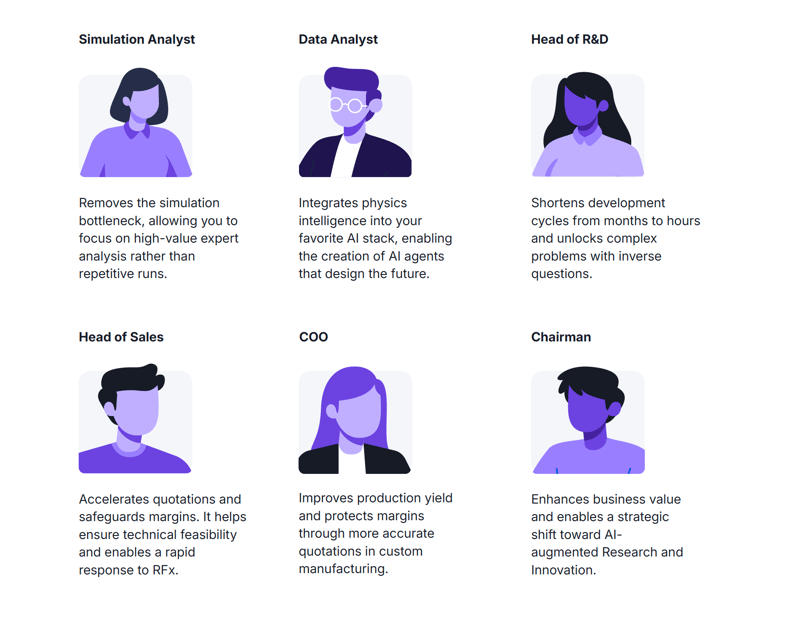
One of the underappreciated aspects of MultiphysicsAI is that its value is not confined to the simulation team. It has a measurable impact on every function that touches product development, and several that do not traditionally touch simulation at all.
For a simulation analyst, the bottleneck of repetitive simulation runs is removed. High-value expert analysis replaces mechanical iteration.
For a head of R&D, development cycles that previously ran to months can be compressed to hours. Inverse design capability means complex performance targets can be set as inputs, not outcomes.
For a head of sales, the ability to rapidly assess technical feasibility accelerates quotations and protects margins on custom work. RFx responses that previously required engineering escalation can be handled directly.
For a COO, MultiphysicsAI improves production yield and reduces the cost of manufacturing variation, particularly relevant in custom or high-mix environments where accurate quotation is critical.
For a data analyst, trained surrogate models integrate directly into existing AI and data science stacks, enabling the construction of physics-aware agents that can operate autonomously within business workflows.
This breadth of impact is what makes MultiphysicsAI strategically different from a simulation speedup. It is not an engineering tool that engineers use faster. It is a business capability.
Industry applications where numbers are real
Automotive: precision sensing for autonomous systems
In the automotive sector, the performance of Inertial Measurement Units (IMUs), has a direct effect on vehicle safety and autonomous driving reliability. IMU performance is sensitive to vibrations and external frequencies, and the device must be matched to its application's drive and sense mode frequencies for optimal operation across the full automotive temperature range.
The traditional approach, time-consuming iterative simulation and manual trade-off analysis, makes it nearly impossible to explore the full parameter space within a product schedule. MultiphysicsAI addresses this directly.
Allsolve generates a dataset of 10,000 randomized geometric and material variants. The trained surrogate model helps engineers identify the exact parameters needed to achieve performance within the desired margin across the operating temperature range. A 100,000-run simulation study that would traditionally take months can be completed in seconds.
The downstream cost reduction is concrete: by eliminating just 1.5 physical prototype cycles, each valued at approximately €125,000 in fabrication, lab fees, and engineering hours, a company saves €187,500 per product line. And in the automotive sector, being six months late to a platform launch can mean millions in lost Tier-1 contracts. Speed has a measurable financial value.
Aerospace: validating resonators for the space environment
Timing devices and resonators used in space applications must maintain frequency stability across thermal environments that range from standard atmosphere to Low Earth Orbit (LEO). The physics involved is genuinely multiphysics: silicon's coefficient of thermal expansion (CTE) becomes negative at low temperatures, causing dramatic shifts in thermoelastic damping.
Validating a temperature-compensated resonator design for this environment traditionally requires weeks of HPC time, coupling structural, thermal, and fluidic domains across the full mission thermal profile.
With MultiphysicsAI, a surrogate trained on 10,000+ coupled Allsolve runs predicts Q-factor variations and frequency shifts across the mission profile in milliseconds. Geometry adjustments that compensate for the negative CTE effect are identified through inverse problem solving. Simulation time is reduced from three weeks to eight hours, with full physics accuracy.
For the space industry, where time-to-orbit is a strategic variable, this compression translates directly into early-mover advantage and the ability to secure government and commercial satellite contracts.
MultiphysicsAI for industries
Discover the impact of MultiphysicsAI on your industry's product development.
Consumer devices: moving yield from 70% to 90%
In high-volume MEMS microspeaker manufacturing, a 70% production yield is often accepted as an industry baseline. The acoustic performance of a MEMS microspeaker, Sound Pressure Level (SPL) and Total Harmonic Distortion (THD), is highly sensitive to picometer-scale geometric variations from manufacturing tolerances. The challenge is not to eliminate these variations, but to design a device whose performance is robust to them.
Allsolve generates 12,500 nonlinear harmonic balance simulations mapping manufacturing geometric variations to SPL and THD outcomes. The trained surrogate identifies design "sweet spots", regions of parameter space where performance meets specification despite manufacturing drift. The result: 30% higher SPL with THD maintained under 0.15%, and production yield improving from 70% to 90%.
At manufacturing scale, a 20-percentage-point yield improvement is equivalent to millions of euros in recovered profit without any increase in material costs. In the semiconductor and consumer electronics space, gross margin improvement of this magnitude has a direct effect on company valuation.
Medical devices: turning supply chain volatility into a solved problem
Consider a medical device manufacturer who has spent years optimizing a PMUT (Piezoelectric Micromachined Ultrasonic Transducer) array for a handheld diagnostic scanner. The design is validated. The process is stable. Then a new batch of piezoelectric material arrives from a supplier, and final devices begin failing sensitivity specifications by 15%.
The traditional response is a crisis: investigate the production line, find nothing wrong, escalate to the materials lab, and wait weeks for characterization. Meanwhile, a choice must be made between stalling production or shipping out-of-spec parts, both with significant business consequences.
With a MultiphysicsAI model trained on the device's physics, the out-of-spec performance data becomes an input to an inverse problem. The surrogate reverse-engineers the probable material properties of the new batch in milliseconds, identifies the root cause of the performance shift, and surfaces fabrication parameter adjustments to compensate. A one-month production delay that would otherwise cost upwards of €500,000 in lost revenue and engineering hours is resolved in days.
This capability does more than fix a problem. It transforms material supply chain variability from a reactive crisis trigger into a manageable, predictable engineering parameter.
The vision ahead: AI agents and democratization
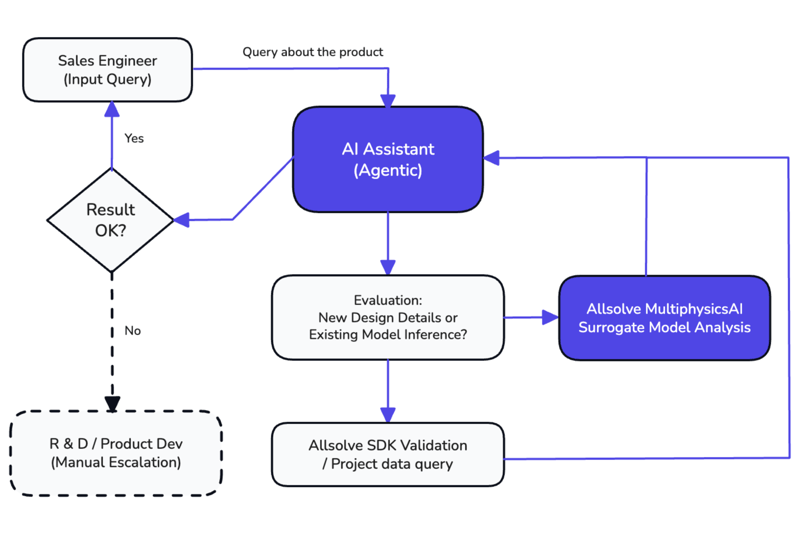
The applications described above are live today. But the longer-term trajectory of MultiphysicsAI points toward something more fundamental: the democratization of physics intelligence across the entire organization.
Today, multiphysics simulation is expert-only. The tools require specialist knowledge; the turnaround time is too slow for real-time decisions; and the results stay within the engineering team. As a consequence, sales, operations, and leadership make decisions without direct access to physics-derived insight.
A trained MultiphysicsAI surrogate, integrated into an AI agent with an accessible interface, changes this. Imagine a sales engineer, not an FEM specialist asking:
"My automotive manufacturer customer wants our accelerometer to operate over a wider temperature range (–40°C to +150°C). Do we need to change the packaging material?"
The AI agent, powered by a MultiphysicsAI surrogate model, provides an actionable answer in seconds, based on real-time mechanical stress predictions, without requiring the question to be escalated to the product development team. The sales engineer can serve the customer immediately. The R&D team remains focused on their core work. The design analysis only reaches them when the RFI advances to a stage that genuinely requires their expertise.
The vision is a future where multiphysics product intelligence is embedded not just in CAE tools, but in CRM, CPQ, ERP, and beyond, making physics accessible to every function that needs it.
A milestone-based path to adoption
The transition to a MultiphysicsAI workflow does not require a full organizational transformation on day one. Quanscient recommends a milestone-based approach designed to deliver value at each stage while maintaining full control over costs and scope.
The process begins with a MultiphysicsAI roadmap assessment, a consultative engagement with your leadership to align AI strategy with your key business initiatives and identify the applications where the benefits will have the highest measurable impact.
From there, a proof of concept (PoC) is scoped around a selected priority application. This covers AI strategy selection, synthetic training data generation with Allsolve, model training and validation in a development environment, and a live demo of the results before any production deployment decision is made.
The final step is rollout and deployment, scaling the validated PoC into a production environment and integrating the model into your core business processes, in collaboration with your IT and business application partners.
At each milestone, the benefit is tangible and the next step is voluntary. This is not a multi-year transformation program. It is an incremental, evidence-based path to a genuine competitive capability.
The next step
Engineering is moving from analysis to intelligence. MultiphysicsAI does not replace your engineers or your simulation infrastructure. It gives them the agility to see every feasible design, the tools to choose the best one, and the speed to do both before your competition does.
If you are ready to explore what a MultiphysicsAI roadmap assessment could look like for your organization, get in touch with Quanscient directly. The first step is a conversation.
Learn more about Quanscient and get in touch now at quanscient.com