Skip to content

Estimation of composite material properties using an inverse approach

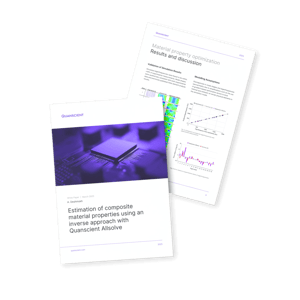
Learn how Quanscient API enable engineers to build and automate efficient proprietary design workflows

6-4

Key takeaways

  • Inverse problems help estimate material properties by minimizing the difference between simulations and experimental data.

  • With an API-driven workflow, Quanscient Allsolve automates this process, reducing manual work and speeding up optimization.

  • Quanscient Allsolve runs simulations in the cloud with parallel computing, significantly reducing processing time.


  • The optimized material properties closely matched experimental data, improving simulation reliability in this case example.

  • Printed circuit boards (PCBs) are one example where this approach might be useful, but the method itself is very general and can be applied to other complex material systems.

Who is this for?

This white paper is for MEMS engineers and designers who want to speed up their product development cycles. It is ideal for those looking to move away from slow manual testing and use automated cloud-based tools to find the right material properties and design configurations faster.

Download white paper

Capture in-depth insights on multiphysics simulations and expert design methodologies.

6-4

Trusted by both industry and academia

Logo of UK Atomic Energy Authority
Logo of Infineon
Logo of Proxima Fusion
Logo of Imec
Logo of Paul Scheffer Institut
Logo of kiutra
Logo of IXI
Logo of Tampere University
Logo of Vexlum
Logo of Krohne
Logo of Albis
Myvox
Abstract-mesh-3
Quanscient Allsolve

See how it could work for you

Submit the form to talk with our experts—we'll respond within 1 business day. You'll learn:

  • How Allsolve could fit your use case
  • What results to expect (accuracy, runtime, design exploration capabilities and rough cost range)
  • How it could plug into your workflow today

Interested in just seeing an on-demand demo? Watch the 3-minute demo here