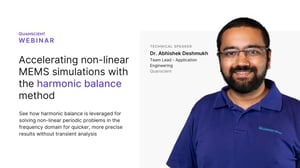

Accelerating nonlinear MEMS simulations with the harmonic balance method
See how harmonic balance is leveraged for solving nonlinear periodic problems in frequency domain for quicker, more precise results without transient analysis.
Quantum computing and CFD in 2026
This 20-minute conversation contains everything you need to know about the current state of quantum computing in physics simulation today.
Introduction to the guest
Prof. Valtteri Lahtinen, Chief Scientist and co-founder of Quanscient, leads quantum algorithms research at Quanscient Quantum Labs—one of, if not the most accomplished teams in the field of quantum algorithms for CFD applications.
In this episode...
We talk about quantum computing in physics, specifically CFD simulation. We discuss what has been achieved so far, what is possible for industry customers right now, what’s next, and what the intermediate steps toward full-blown quantum advantage look like in practice.
Some problems, like the full aerodynamics of a cruising plane, require more memory than classical supercomputers will ever have.
Rather than just making old math faster, Quanscient uses "Lattice" methods that are built to speak the natural language of quantum computers.
Every time you add a "qubit" to a quantum computer, the size of the problem you can simulate potentially doubles.
Quanscient recently proved the tech works by running a 3D fluid simulation on a 54-qubit quantum chip—a major milestone for the industry.
We can use quantum computers to generate highly specialized data that "teaches" AI models how to handle complex turbulence.
Fluid dynamics is messy and non-linear; Valtteri’s team is using machine learning to help quantum chips navigate these complex equations.
We expect the first "real-world" advantages to appear in 2–3 years for specific, high-value engineering tasks.
Major aerospace companies are starting now because waiting until the tech is "perfect" means it’s already too late to catch up.
Listen to the full episode on YouTube
0:00 Intro
1:05 Introduction to Quanscient Quantum Labs
2:46 Quantum computers and physics
6:13 Quantum vs classical computation
7:42 Real-world tests of algorithms
9:19 When will we see quantum advantage?
12:33 The benefits of quantum already today
14:42 Quantum and artificial intelligence
17:41 What's next from Quantum Labs?
19:28 The purpose of the work
20:49 Outro
Learn more about the Quantum Labs
Read more and find all resources on the Quantum Labs webpage.
Learn more about the topics
Press release
World-first 3D advection-diffusion simulatiom
Read the press release from our world-first quantum CFD simulation on IQM’s Crystal 54-qubit Emerald chip through the IQM Resonance platform.
Open the press release →

Blog
Efficient physics-informed learning with built-in uncertainty awareness
In this blog article, we introduce QO-SPINNs, a new architecture that combines quantum-inspired layers with separable networks to enable efficient, stable, and uncertainty-aware physics simulations.
Open the blog →

Press release
Quanscient, Oxford Ionics, and Airbus collaboration
Read the press release from our partnership with Oxford Ionics and Airbus on exploring the potential of quantum computing for CFD for aerospace.
Open the press release →