
Monte Carlo analysis for multiphysics simulation
Simulate manufacturing and material variations to see how they impact real-world device performance.

.png?width=300&name=Monte%20Carlo%20page%20hero%20image%20(2).png)
Why Monte Carlo analysis?

Simulate small variations to see how they affect device performance.

Predict differences between theoretical expectations and real-life behavior.

Estimate manufacturing yield using pass/fail criteria.

Bridge the gap between simulation results and actual device performance.
How Monte Carlo analysis works
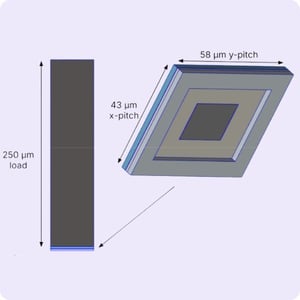
Select the key design variables and assign statistical distributions to represent real-world manufacturing or material variations.
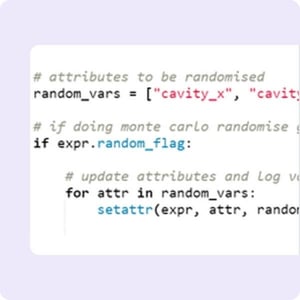
With custom Python scripting feature, set up specialized analyses. Modify existing scripts to add custom functionality, such as randomizing dimensions.
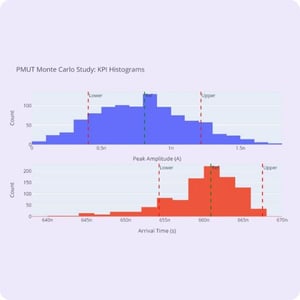
Simulate each design and measure performance using pass/fail criteria.
.jpg?width=300&name=Website%20images%20(8).jpg)
Find which variables affect performance most and adjust the design to improve reliability and yield.
Ultrasound transducer
Manufacturing variations were sampled, the Monte Carlo analysis quantified their impact, and Quanscient Allsolve verified PMUT designs with improved robustness and predictable yield. Open the article -->
.png)
1. Realistic variability modelling
1,000 simulations apply random variations to PMUT stack dimensions using a normal distribution to reflect manufacturing and material variations.
View full-size.png)
2. Efficient large-scale simulation
All simulations are executed in parallel, enabling rapid evaluation of statistically significant design variations.
View full-size.png)
3. Clear sensitivity identification
Correlation and cross-plot analysis reveal which geometric dimensions most strongly affect signal amplitude and arrival time.
View full-size.png)
4. Quantitative yield assessment and result
Using pass/fail limits of ±50% for signal amplitude and ±1% for arrival time, KPI histograms quantify design stability, resulting in a 79% predicted manufacturing yield.
View full-size
MEMS microspeakers
With MultiphysicsAI and Monte Carlo analysis, thousands of design variations were explored in minutes, a 72% yield within quality limits was predicted, and high-fidelity simulations confirmed the accuracy of the results. Open white paper -->
1. Apply manufacturing variations with MultiphysicsAI
Start from the optimal design and vary key dimensions to reflect manufacturing tolerances. The AI surrogate generates thousands of variations quickly, avoiding full simulations for each case.
View full-size
2. Simulate performance across variations
Run the Monte Carlo analysis using MultiphysicsAI to predict the impact of these variations on device performance across 10,000 virtual prototypes.
View full-size
3. Estimate yield
Set acceptable performance limits and calculate how many designs meet the criteria. In this case, 72% of the designs satisfy the quality requirements.
View full-size
4. Validate and refine AI predictions
Use a small set of high-fidelity simulations to check and correct the AI surrogate. This ensures accuracy while keeping computational cost low.
View full-size
Cloud-powered multiphysics simulation platform

Natively coupled multiphysics
Simulate electrical, mechanical, and acoustic interactions in one unified model.

1000x throughput with the cloud
Run large-scale models and design studies faster with parallelized cloud computing.

Tests with real-world conditions
Estimate manufacturing yield by taking into account real-world conditions and manufacturing constraints.

Physics-aware artificial intelligence
Create proprietary training data in hours, use neural networks to predict model performance in milliseconds. Real-time design space exploration.

See how Allsolve could work for you
Get in touch with us now to see how Allsolve can help with your specific challenges
Case examples and other resources

Case example
Optimizing designs by simulating thousands of design variations
Explore a case study covering running thousands of simulations in parallel with Quanscient Allsolve.
Open the article →
%20(1).jpg?width=300&name=event-listing-1%20(4)%20(1).jpg)
White paper
Quanscient MultiphysicsAI for MEMS design and optimization
A full breakdown of a MEMS microspeaker case with AI-driven design exploration.
Open white paper →

See how it could work for you
Submit the form to talk with our experts—we'll respond within 1 business day. You'll learn:
- How Allsolve could fit your use case
- What results to expect (accuracy, runtime, design exploration capabilities and rough cost range)
- How it could plug into your workflow today
Interested in just seeing an on-demand demo? Watch the 3-minute demo here