
Stellarator magnet quench
Simulating quench events in stellarator fusion magnets (42M+ DoF)
Collaborators


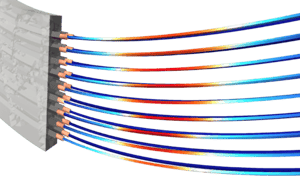
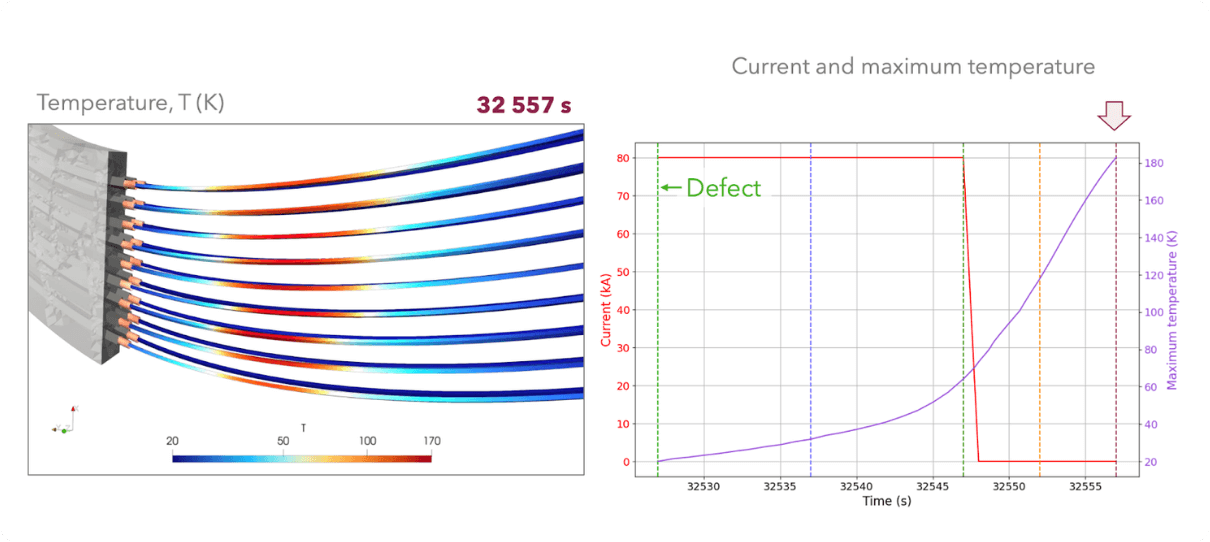
High-Temperature Superconducting (HTS) magnets in fusion reactors face the risk of "quench"—a sudden loss of superconductivity that creates dangerous hotspots.
Simulating a full-scale non-planar Stellarator coil is notoriously difficult because the model requires tens of millions of unknowns to capture the intricate Non-Insulated (NI) winding geometry, often crashing traditional local solvers.
The team used Quanscient Allsolve’s Domain Decomposition Method (DDM) to distribute the computational load across the cloud.
They successfully modeled a 42 Million Degree-of-Freedom (DoF) transient simulation, coupling magnetoquasistatic and thermodynamic physics to capture the complex current redistribution and thermal propagation inside the coil during a fault scenario.