
5G component optimization
Accelerating 5G component optimization via high-throughput simulation (12,000+ runs)

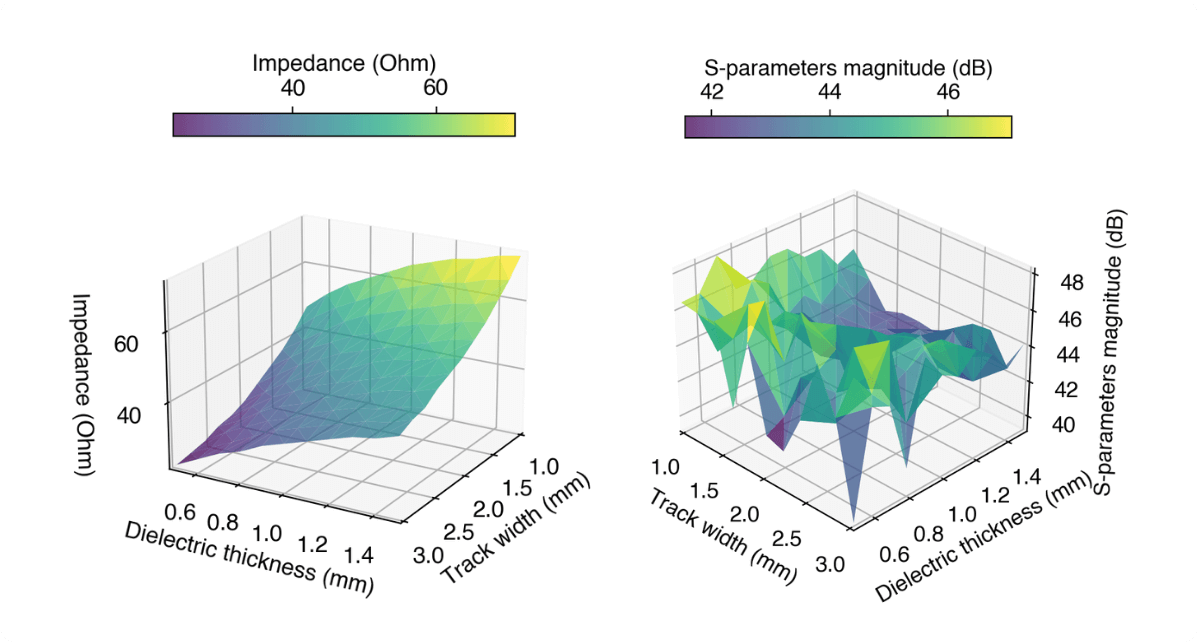
Grounded Coplanar Waveguides (GCPWs) are critical for 5G and automotive radar, but optimizing them for impedance matching and minimal signal loss requires balancing multiple geometric parameters (track width, gap, dielectric thickness).
Finding the optimal configuration requires exploring a massive design space, often involving thousands of iterations—a task that takes weeks on traditional desktop workstations.
The study leveraged Quanscient Allsolve’s cloud scaling to perform a massive design exploration study of 12,000 unique GCPW configurations.
The simulation utilized Finite Element Method (FEM) solvers with a structured mesh optimization study to balance accuracy and speed, sweeping parameters including relative permittivity, frequency, and physical geometry simultaneously.