
Superconducting wire AC losses
Accelerating superconducting AC loss simulation: 8 days to 1.7 hours
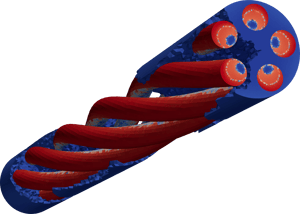
Simulating AC losses in twisted superconducting wires is computationally exhausting. The standard "H-Formulation" solves for vector fields everywhere, leading to millions of unnecessary Degrees of Freedom (DoF) in the non-conducting air regions.
This inefficiency results in ill-conditioned matrices and massive runtimes. In a benchmark study, a standard 3D twisted wire simulation took ~8 days to solve on a high-end 96-core on-premise server.
The team implemented the H-phi Formulation on Quanscient Allsolve. This hybrid method solves for the magnetic field (H) inside the conductor but switches to a scalar potential (phi) in the air, drastically reducing model size.
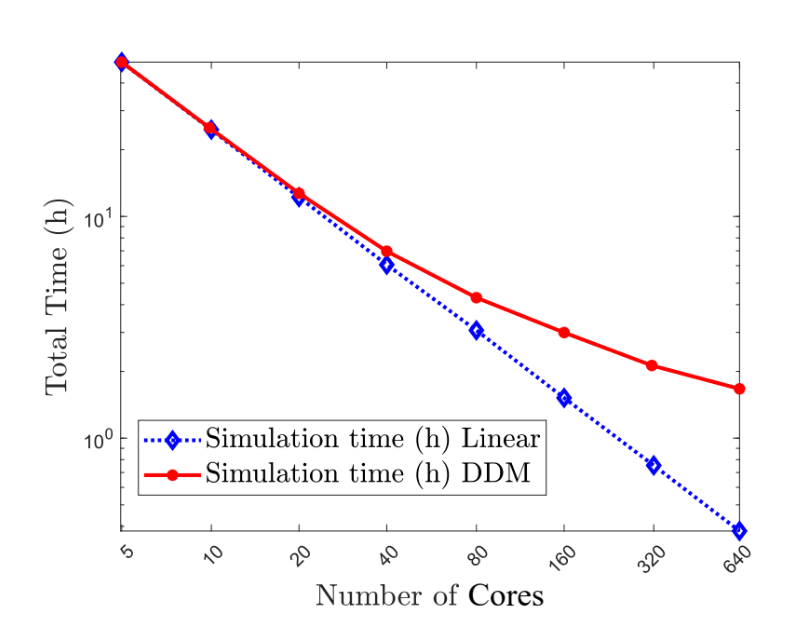
Combined with Cloud Domain Decomposition (DDM), the team distributed the calculation across 640 cloud cores to maximize throughput.