Skip to content

Be the first to quantum advantage in CFD

Build algorithms with us today, benefit immediately from quantum-scale simulation as hardware matures.

Aerospace  •  Maritime  •  Automotive

Organization we work with

Airbus-logo-quantum
IBM
IQM-logo-quantum
ion-q-logo-quantum
aqt-logo-quantum
atom-computing-logo-qantum
nqcc-logo-quantum
oxford-ionics-logo-quantum
vtt-logo-quantum
haiqu-logo-quantum
q-ctrl-logo-quantum

Partner with us to start developing quantum algorithms for physics simulations today

loading-01 (1)

Quantum computing offers the potential for unparalleled accuracy and speed for physics simulation.

waves (1)

Quantum Labs, our in-house research group, is the world-leading team in the quantum lattice Boltzmann method (QLBM), specializing in computational fluid dynamics (CFD).

atom-02 (1)

We work with our pilot customers for custom algorithm development.

Why quantum?

The power of quantum computers lies in their ability to perform complex calculations at a speed and accuracy that is unattainable by classical computers.

This makes them a game-changer for physics simulations, particularly in fields such as computational fluid dynamics (CFD).

Our research and development on quantum-native algorithms show tremendous potential for simulating systems larger and more complex than ever imaginable with great precision.

As quantum hardware matures, this will translate into fewer physical tests, faster design cycles, and significantly lower R&D costs.

What we offer?

Quantum hardware is not yet at broad practical advantage, but it is advancing quickly and useful commercial applications are getting closer every year.

The algorithms you will need when that happens take years to develop and validate.

By working with us as a pilot customer, you can co-develop quantum-native algorithms now and position yourself among the first to benefit from quantum computing in CFD simulations.

Our team helps you identify high-value use cases, design and test algorithms, and define how quantum computing will eventually be integrated into your existing workflows.

You gain early access to the technology, a clear roadmap, and internal know-how that helps you stay ahead as quantum computing becomes commercially viable.


Industries we work with

Large-scale problems with CFD

airplane (quantum v2)
Aerospace

Full-aircraft aerodynamics, wing–body–engine interactions, drag and fuel-burn reduction.

ship (quantum v2)
Maritime

Hull and propeller hydrodynamics, resistance and cavitation control, improved fuel efficiency.

car (quantum v2)
Automotive

External aerodynamics, underbody and cooling airflow, vehicle range and high-speed stability.

Example

How a pilot project works

target-icon
1. Identify use case

Define a high-value simulation problem and success criteria together.

atom-quantum-icon
2. Evaluate quantum potential

Assess quantum potential and design a suitable algorithmic approach.

code-icon
3. Develop and benchmark

Develop and test quantum-native algorithms against your classical baselines.

route-roadmap-icon
4. Plan the rollout

Plan integration, hardware timelines, and next steps for scaling.

Quanscient Quantum Labs

Team snapshot

Quanscient Quantum Labs is an award-winning team of pioneers responsible for the world’s first multiphysics and 3D CFD simulations on real quantum hardware.

Researchers and algorithm developers

Designing and implementing quantum algorithms for CFD on real hardware.

7-3
Patents filed

Covering novel quantum algorithms and lattice-based methods for simulation.

3
World-first simulations

From the first CFD on real quantum hardware to the first 3D advection–diffusion on a superconducting chip.

harmonic-balance-2-1

Start exploring quantum-powered simulations

The best time to get started is now

Press & news

Latest announcements

iqm-pr
Press release

First 3D diffusion simulation on IQM superconducting quantum chip

July 14, 2025

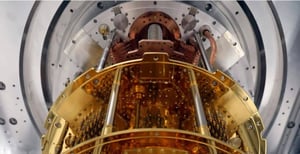
Quanscient achieved a major milestone by performing the first-ever 3D advection-diffusion simulation using the Quantum Lattice Boltzmann Method (QLBM).

Read the full article →
vtt-pr
Press release

World-first quantum CFD simulation at VTT and IQM 50-Qubit launch event

March 5, 2025

At the launch of Europe’s first 50-qubit computer, Quanscient demonstrated the world’s first multi-time-step QLBM simulation on superconducting quantum hardware.

Read the full article →

airbus-pr
Press release

Quanscient, Oxford Ionics, and Airbus to explore quantum computing for CFD

February 25, 2025

Quanscient, Oxford Ionics, and Airbus are partnering to explore the potential of quantum computing to improve computational fluid dynamics simulations for aerospace applications. 

Read the full article →

Abstract-mesh-3
Quanscient Quantum Labs

Take the first step of exploring quantum CFD now

Submit the form to talk with our experts—we'll respond within 1 business day. 

Transportation and maritime
 
Aerodynamic optimization

More accuracy, more scale -> optimize designs, reduce drag, improve fuel efficiency, and increase speeds.


Thermal management

Managing the heat generated in high-speed aircraft and spacecraft, preventing overheating and enhancing structural durability.


Noise reduction

Coupling CFD with acoustics enables the prediction and minimization of noise generated by aircraft engines, airframe, and airflow interactions, improving compliance with noise regulations.


Hypersonic and reentry analysis

Large-scale CFD can simulate extreme conditions encountered by hypersonic vehicles or spacecraft during reentry, where both high temperatures and high-speed flows are involved.


Thermal management of electric vehicles (EVs)

With large batteries and cooling requirements, combining CFD with thermal simulations helps design efficient cooling systems to avoid overheating and extend battery life.


Passenger comfort (noise & vibration)

CFD simulations integrated with acoustics can help reduce cabin noise by analyzing airflow around and through the vehicle, enhancing passenger comfort.


Ship hull and propeller design

High-fidelity CFD simulations are used to design hulls and propellers that minimize drag and improve fuel efficiency.


Acoustics for submarine stealth

CFD-acoustic simulations help minimize noise and vibration in submarines, making them harder to detect.

Energy and resource optimization
 
Wind farm optimization

Large-scale CFD simulations model wind flow across complex terrains and turbine placements to maximize energy output and reduce wake effects that could impact neighboring turbines.


Reservoir simulation and enhanced oil recovery

CFD aids in understanding fluid flows within reservoirs, enhancing extraction processes, and optimizing resource recovery.


Subsea pipeline flow assurance

Large-scale multiphase CFD simulations model oil, gas, and water flows, predicting hydrate formation and helping to design solutions for uninterrupted flow in extreme subsea environments.


Coolant flow in nuclear reactors

CFD-thermal simulations are crucial for optimizing coolant flow in nuclear reactors, helping to prevent overheating and ensuring safe, efficient reactor operation.


Radiation heat transfer

Multiphysics simulations enable engineers to understand and control heat transfer via radiation, which is essential in high-temperature nuclear environments.

Civil engineering and urban planning
 
Wind flow and heat dispersion in urban environments

Large-scale CFD simulations provide insights into wind patterns and temperature distributions in urban areas, crucial for city planning and improving building energy efficiency.


Fire spread in enclosed spaces

CFD simulations combined with thermal analysis help design safer building layouts and ventilation systems by modeling fire and smoke propagation in large enclosed spaces like tunnels, stadiums, and skyscrapers.


Noise reduction

Coupling CFD with acoustics enables the prediction and minimization of noise generated by aircraft engines, airframe, and airflow interactions, improving compliance with noise regulations.


Air quality and pollution dispersion

CFD simulations model the dispersion of pollutants in air, predicting the impact of industrial emissions, vehicle exhaust, and wildfire smoke on air quality in urban and rural environments.


Water flow and contaminant spread

In riverine and coastal areas, CFD is used to predict water flow and contaminant dispersion, which is critical for environmental conservation and managing water resources.


Environmental noise pollution prediction and mitigation

Simulating and controlling noise pollution from urban environments, airports, highways, and industrial facilities.


Seismic acoustics and earthquake simulation

Simulating the propagation of seismic waves through the Earth’s crust to better understand earthquake behavior and ground shaking.

Electronics and semiconductor
 
Cooling in data centers

CFD and thermal simulations are used to design cooling solutions for data centers, optimizing airflow and temperature control to prevent overheating and reduce energy consumption.


Thermal management in high-performance electronics

CFD-thermal simulations help in the design of cooling solutions for microprocessors and power electronics, essential for avoiding overheating in compact and high-performance electronic devices.